Understanding Nanotechnology: Costs, Benefits, and Future Implications
Nanotechnology is revolutionizing various fields through its applications in materials, health, and communication. By manipulating matter at the nanoscale, it enables innovations such as nanopowders, molecular precision, and potentially self-replicating machines. The costs and benefits of nanotechnology must be evaluated critically, as it brings transformative changes to our daily lives, enhancing food safety, shelter, transportation, and healthcare. This exploration seeks to assess how we can influence and adapt to nanotechnology's growing role in society.

Understanding Nanotechnology: Costs, Benefits, and Future Implications
E N D
Presentation Transcript
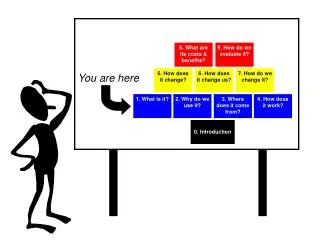
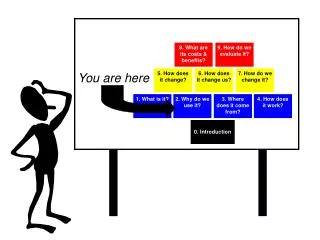
8. What are its costs & benefits? 9. How do we evaluate it? 5. How does it change? 6. How does it change us? 7. How do we change it? 1. What is it? 2. Why do we use it? 3. Where does it come from? 4. How does it work? 0. Introduction You are here
Review: What is nanotechnology? • Nanopowders and nanomaterials (pants, sunscreen) • Molecular precision (solar cells, light emitting diodes) • Nanoscale machines (none yet) • Matter compilers (read Diamond Age) • Self-replicating robots (read Prey)
Why do (or will) we use Nanotechnology? • Food • Shelter • Communication • Transportation • Commerce • Art • Religion • Health • Entertainment • Organization • Conflict • Exploration
Why do (or will) we use Nanotechnology? • Food (detects when food is spoiled http://www.packworld.com/articles/Features/18256.html) • Shelter (aerogel insulation now, diamond windows later – see Diamond Age) • Communication (optical switching) • Transportation (space elevator http://www.nanotech-now.com/Art_Gallery/LiftPort.htm) • Commerce (matter compilers could create products where needed, selling only designs) • Art (Maya Blue 1200 years ago) • Religion (who’d have expected GPS to be used to find Mecca? http://www.primidi.com/2004/08/16.html) • Health (Nanomedicine by Robert Freitas at http://www.nanomedicine.com/NMI.htm) • Entertainment (display phosphors, utility fog http://discuss.foresight.org/~josh/Ufog.html) • Organization (pervasive surveillance for law enforcement, contact lens HUD) • Conflict (nanoscale sensors, both stationary and mobile) • Exploration (lens for evanescent waves to view atomic scale, smaller space probes)