The Rise of Totalitarian Regimes: Stalin, Mussolini, and Hitler in the 20th Century
This overview examines the establishment and implications of totalitarian governments under Stalin in the Soviet Union, Mussolini in Italy, and Hitler in Germany during the 20th century. After Lenin's death in 1924, Stalin transformed the Soviet Union into a totalitarian state where dissent was brutally suppressed. Mussolini leveraged public discontent following the Versailles Treaty to propel Fascism in Italy, controlling all political expression. Hitler's Nazi regime capitalized on national grievances from World War I, enacting extreme nationalism and militarism. These dictators shaped the political landscape leading to World War II.

The Rise of Totalitarian Regimes: Stalin, Mussolini, and Hitler in the 20th Century
E N D
Presentation Transcript
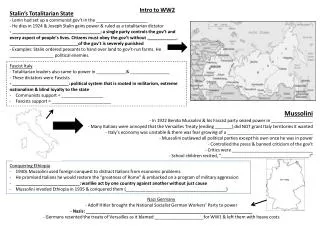
Stalin’s Totalitarian State • - Lenin had set up a communist gov’t in the _____________________ • - He dies in 1924 & Joseph Stalin gains power & ruled as a totalitarian dictator • - ____________________________________: a single party controls the gov’t and every aspect of people’s lives. Citizens must obey the gov’t without ____________. ____________________________of the gov’t is severely punished • - Examples: Stalin ordered peasants to hand over land to gov’t-run farms. He __________________ political enemies. • Fascist Italy • - Totalitarian leaders also came to power in ____________& ________________ • - These dictators were Fascists • - _______________________: political system that is rooted in militarism, extreme nationalism & blind loyalty to the state • Communists support = _________________ • Fascists support = ________________________ Intro to WW2 • Mussolini • - In 1922 Benito Mussolini & his Fascist party seized power in _________________ • - Many Italians were annoyed that the Versailles Treaty (ending _______) did NOT grant Italy territories it wanted • - Italy’s economy was unstable & there was fear growing of a ___________________________________ • - Mussolini outlawed all political parties except his own once he was in power • - Controlled the press & banned criticism of the gov’t • - Critics were _________________________________ • - School children recited, “____________________________________!” • Conquering Ethiopia • 1930s Mussolini used foreign conquest to distract Italians from economic problems • He promised Italians he would restore the “greatness of Rome” & embarked on a program of military aggression • __________________________: warlike act by one country against another without just cause • Mussolini invaded Ethiopia in 1935 & conquered them (_________________________________________) • Nazi Germany • - Adolf Hitler brought the National Socialist German Workers’ Party to power • - Nazis: ____________________________________________________________________ • - Germans resented the treaty of Versailles as it blamed ____________________for WW1 & left them with heavy costs