Understanding Management: Concepts, Perspectives, and Strategies in a Globalized Environment
This lecture outlines key themes in management, exploring rationality, strategy, globalization, and performance. It delves into Henri Fayol's four activities of management: planning, organizing, directing, and controlling. Major perspectives, including science, political, control, and practice, provide a comprehensive view of managerial roles. The discussion also addresses contemporary issues such as educational levels, diversity, and the impact of harassment on productivity. It culminates in examining strategic management, emphasizing the integration of various managerial levels and the challenges posed by globalization.

Understanding Management: Concepts, Perspectives, and Strategies in a Globalized Environment
E N D
Presentation Transcript
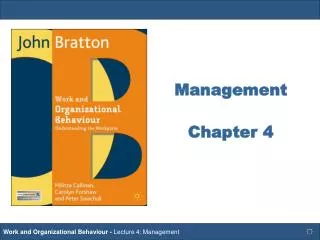
Management Chapter 4
Introduction This lecture will: • Make an outline definition of management themes • Explore the concepts of rationality and strategy • Explore issues of globalization and decision-making • Examine management performance.
The Meaning of Management • Derived from the Italian ‘maneggiare’ meaning to handle or train horses: • Fayol defined management as four key activities – • Planning • Organizing • Directing • Controlling • Drucker – management fulfils the needs of social justice • The organization is a formal structure and its staff needs are varied – line and staff management • Sociological approaches emphasises power • OB – relates to the behaviour of managers.
Major Perspectives on Management Four perspectives can be identified: • The Science Perspective • The Political Perspective • The Control Perspective • The Practice Perspective: • Synthesises the other perspectives • Practices include: Primary and Secondary social practices
The Process of Management (1) • Recent approaches have shown the limits of managerial rationality: • Mintzberg and Carlson have shown that interruption and superficial activity are a feature of management • Mintzberg classified work into ten roles with three sets of behaviours • Kotter challenged technical rationality and distinguished demands associated with task responsibilities from demands linked to relationships
The Process of Management (2) Recent research has also emphasised the following themes: • Level of education of co-workers • The diversity of managerial activities and importance of environmental scanning • Hales has suggested the value of rationality • Gender and cross-cultural aspects • Harassment and bullying have been linked to certain kinds of production - These various themes have been related to issues of conflict and power
Managerial Rationality It is also possible to ask ‘why’ managers do what they do. A variety of approaches to this question exist, including: • The Neoclassical Approach • The Contingency Approach • The Political Approach • The Labour Process Approach.
Rationality – Neoclassical Approach • Emphasises the managers as agent of the owner and the maximisation of profit • The market is key • It becomes rational to obey managers, in accordance with Weber’s notion of legitimacy
Rationality – Contingency Approach • Looks to the internal structure of the firm and its match to the environment • Woodward adopted this approach in her study of manufacturing technology • Proposes a link between rationality, structure and technical complexity of firm processes • Organic or small batch production can be seen as more effective in certain situations
Rationality – Political Approach • Elements of stakeholder and resource dependency theories are incorporated • Focuses on power relationships as causal in management behaviour • Management can be viewed as an elite in a coalition of stakeholder groups which can also include external parties (stakeholder theory)
Rationality – Labour Process Approach • Management is viewed as economically exploitative and socially alienating • Maximum output is extracted at minimum cost (Braverman) • The rationality issue relates also to strategic choice theory which view gives the choices of elite some force in the market
Strategic Management • Goes beyond rationalistic approaches and includes a consideration of power and markets • It is possible to systematise a view of strategy as having five steps – • Mission and goals • Environmental analysis • Strategy formulation • Implementation • Evaluation
Porter’s Hierarchy of Strategy • Porter divided multi-divisional firm units into three main levels: • Corporate Level Strategy • Business Level Strategy • Functional Level Strategy • An integration of these levels is emphasised in the area of strategy formulation
Global Capitalism and Managerial Behaviour • Hertz describes globalization as ‘the unfettered pursuit of profit’ • Factors include: • Economies of scale and low cost leadership • Tensions faced to cut costs and to create product differentiation, at global levels • The drive towards efficiency: integration of product and control systems in technological areas • Taking into account national regulatory requirements
Figure 4.7 - An Integrated Model of Management The inter-linked behaviour’s and contingencies suggest management is a multi-dimensional integrating and controlling activity (Hales)
Figure 4.8 - The Behaviour of Successful Managers A more individualized view of managerial work can be created – the link between theory and performance is, however, complex and rarely predictive.