Understanding Gymnosperms: Characteristics, Reproduction, and Economic Uses
This session explores gymnosperms, a group of plants with naked seeds not enclosed in fruits or flowers. They thrive in high altitudes, exhibit woody structures, and have unique reproductive processes. Key aspects include the fertilization of ovules, the role of seeds in protection and dormancy, and adaptations of conifers to dry climates. Additionally, we discuss the diversity of conifer species and their economic applications, from lumber and turpentine to their use in medicine. Explore the remarkable world of these ancient plants and their significance in our ecosystem.

Understanding Gymnosperms: Characteristics, Reproduction, and Economic Uses
E N D
Presentation Transcript
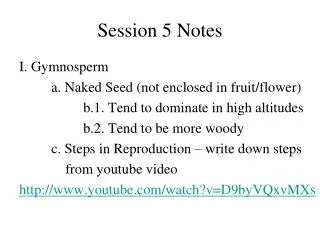
Session 5 Notes I. Gymnosperm a. Naked Seed (not enclosed in fruit/flower) b.1. Tend to dominate in high altitudes b.2. Tend to be more woody c. Steps in Reproduction – write down steps from youtube video http://www.youtube.com/watch?v=D9byVQxvMXs
d. fertilized ovule (mature ovule) e. embryo, food reserves, seed coat f.1.i. 5 months g. 1. Seed provides protection from the environment g.2. Seed coat allows for a period of dormancy until conditions are favorable for germination i. Warmth ii. Moisture
g. 3.i. reduce competition with parent ‘ a. root space b. light g.3.ii. Independence from water for fertilization
Conifers I.a.i. Originated 300 million years ago I.a.ii. Weather became colder and drier I.a.iii. Conifers became xerophytic (dry adapted) I.b.i. Small needle like leaves I.b.ii. Thick cuticle to prevent water loss I.b.iii. Sunken Stomata I.c. evergreens I.d.i. needles
Conifer Diversity b. (tallest tree, about 350 feet) b.ii. 90% of virgin forest c. 30 feet e. flavor gin f. have anti-carcinogenic…Taxol f.i. 6 trees to treat 1 patient g. About 600 species
Economic Uses • Ornamental • Lumber • Pine Nuts • Turpentine • Paper • Any others??
Conifer Diversity b. (tallest tree, about 350 feet) b.ii. 90% of virgin forest c. 30 feet e. flavor gin f. have anti-carcinogenic…Taxol f.i. 6 trees to treat 1 patient g. About 600 species