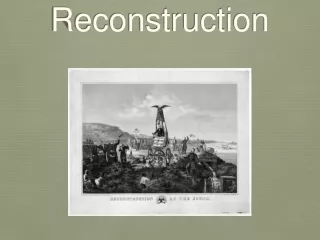
RECONSTRUCTION
The Reconstruction Era followed the Civil War, marked by significant political and social changes in the United States. Under President Andrew Johnson, the Black Codes were enacted, and key constitutional amendments were passed: the 13th (1865), the 14th (1866), and the 15th (1870). The Military Reconstruction Act of 1867 reshaped the South, while the Tenure of Office Act and Johnson's impeachment highlighted political tensions. The rise of the Ku Klux Klan and economic upheavals such as the Panic of 1873 further complicated the period, culminating in the contentious election of 1876.

RECONSTRUCTION
E N D
Presentation Transcript
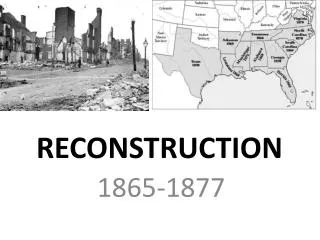
RECONSTRUCTION 1865 - 1877
1865 • President Johnson continues Lincoln style Reconstruction • Black Codes Enacted • 13th Amendment passed
1866 • 14th Amendment passed rejected by southern states • Election of 1866
1867 • Military Reconstruction Act is passed • Tenure of Office act passed
1868 • Impeachment /acquittal of Andrew Johnson • Readmission of some southern states • 14th Amendment ratified • US Grant elected • Some amnesty granted
1870 • 15th Amendment • 1st Enforcer Act
1871 • KKK Act is passed • Second Enforcer Act passed
1872 - Amnesty Act, Grant re-elected, Greenbacks • 1873 – Panic of 1873, gold standard • 1874 – Democrats win H. of R. • 1875 – Grant admin. Corruption, Civil rights Act, Greenback conversion • 1876 – US v. Reese “does not guarantee right to vote • US v. Crukshank “ US has not right to intervene in private discrimination 1877 – Congress elects Rutherford B Hayes President after disputes in general election lead many to believe Samuel Tilden is winner