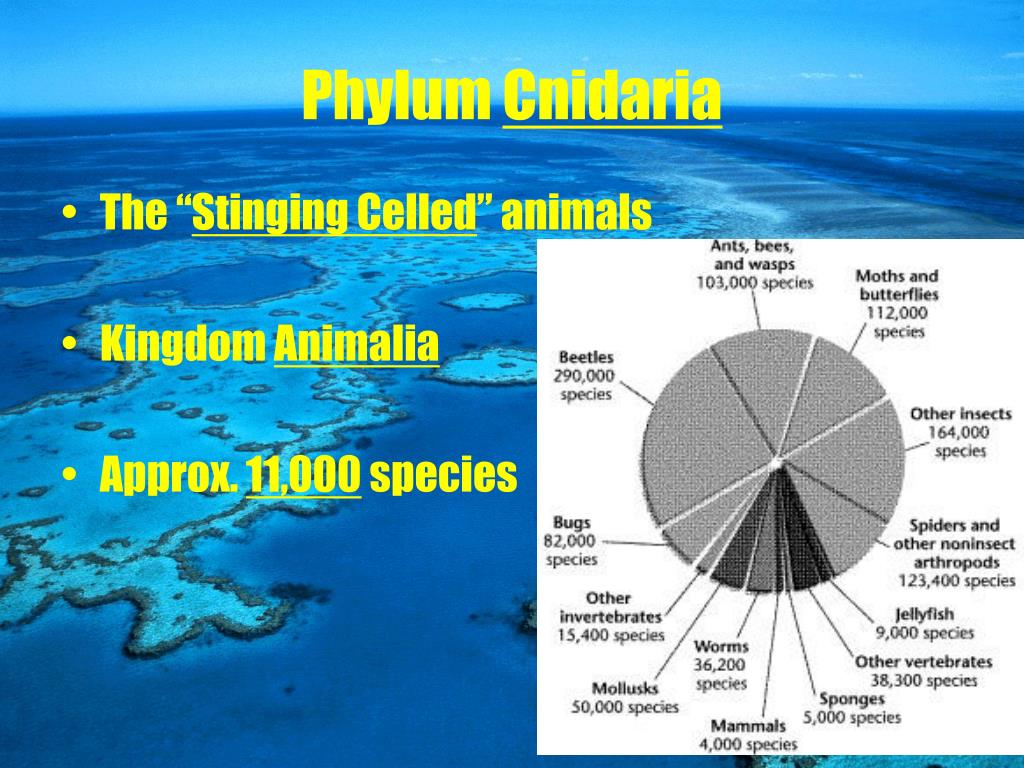
Phylum Cnidaria • The “Stinging Celled” animals • Kingdom Animalia • Approx. 11,000 species
Cnidarian Habitat • All live in water -aquatic • Most live in saltwater - marine • Few are freshwater – ex. Hydra
Cnidarian Movement • Some can move • (motile) • Some cannot move • (non-motile)
General Cnidarian Info • All are consumers • They get food with stinging cells • Cnidocytes • Cnidocytes cover the tentacles only • Prey is captured in tentacles & stung to death • When prey is dead it is stuffed into the gut
Diagram of Nematocyst
General Cnidarian Info • What do they eat? • Depends on the size • Fish, worms, microorganisms, etc • Cnidarians are Chunk Feeders • Not filter feeders like sponges
Body Forms • Polyp – tube with tentacles pointing up • Often sessile (attached) • Medusa – umbrella with tentacles hanging down • Often float or use jet propulsion
Symmetry • Radial symmetry (wheel-like body plan) • No head/tail or front/back
Cnidarian Body Structure • Inner Wall (Endoderm) • 3 kinds of cells • Cells that make digestive enzymes • Cells with flagella to circulate fresh water from outside • Cells that contain partially digested food which is absorbed into the body • Outer wall - Ectoderm – skin layer for protection • Middle – Jelly layer - mesoglea • contains nerve net • Hollow gut – Gastrovascular cavity
Cnidarian Reproduction • Reproduction – sexual or asexual • Sexual – two parents - Sperm & Egg • Asexual – one parent - budding
Coelenterate Examples Jellyfish, Portuguese Man-of-War, Sea Anemone, Coral, Hydra
Jellyfish • Named for thick layer of mesoglea • Body form = Medusa • Size – from a few mm to a few meters • Dangerous Examples: • Sea Wasp Jellyfish • Box Jellyfish
Jellyfish Pictures
Portuguese Man-of-War • Looks like a floating plastic bag • Body form – Colonial • Some polyp • Some medusa • Size – from a few cm to over 1 meter
Portuguese Man-of-War • Some are dangerous to humans, possibly even deadly
Sea Anemone • Named for a flower • Body form = polyp • Size – from a few cm to over 1 meter • Mostly non-motile, but some can glide slowly
Sea Anemone • Many species live with a clownfish – this is a Mutualistic Relationship • The fish gets protection • The anemone gets food lured by the brightly colored fish
Coral • All are non-motile • Body form – Polyp • Size rarely larger than 1 mm • Protection – build a crater of limestone around body
Coral • Coral reefs • Largest Coral Reef • Great Barrier Reef in Australia
Hydra • All live in freshwater • Body form – polyp • Size – max. ½ inch • Move by gliding, somersaulting, floating
Comparing Sponges & Coelenterates • Number (#) of Species • Habitat • Symmetry • Feeding • Reproduction • Movement
Sponges Approx. 5,000 Coelenterates Approx. 11, 000 Comparing Sponges & CoelenteratesNumber (#) of Species
Sponges Mostly saltwater (marine) Some freshwater Coelenterates Mostly saltwater (marine) Some freshwater Comparing Sponges & CoelenteratesHabitat
Sponges Radial (wheel-like) Coelenterates Radial (wheel-like) Comparing Sponges & CoelenteratesSymmetry
Sponges Filter Feeders Bacteria, algae, protozoans Coelenterates Chunk Feeders Fish, worms, some microorganisms Comparing Sponges & CoelenteratesFeeding Habits
Sponges Sexual – sperm & egg Asexual – budding regeneration gemmules Coelenterates Sexual – sperm & egg Asexual - budding Comparing Sponges & CoelenteratesReproduction
Sponges All sessile (non-motile) Coelenterates Some motile Some sessile Comparing Sponges & CoelenteratesMovement