SlideServe
Menu
Préférences
© SlideServe · v2026

Phylum Cnidaria

lok avatar
12 diapositives · 1.2K Views · Jul 04, 2012

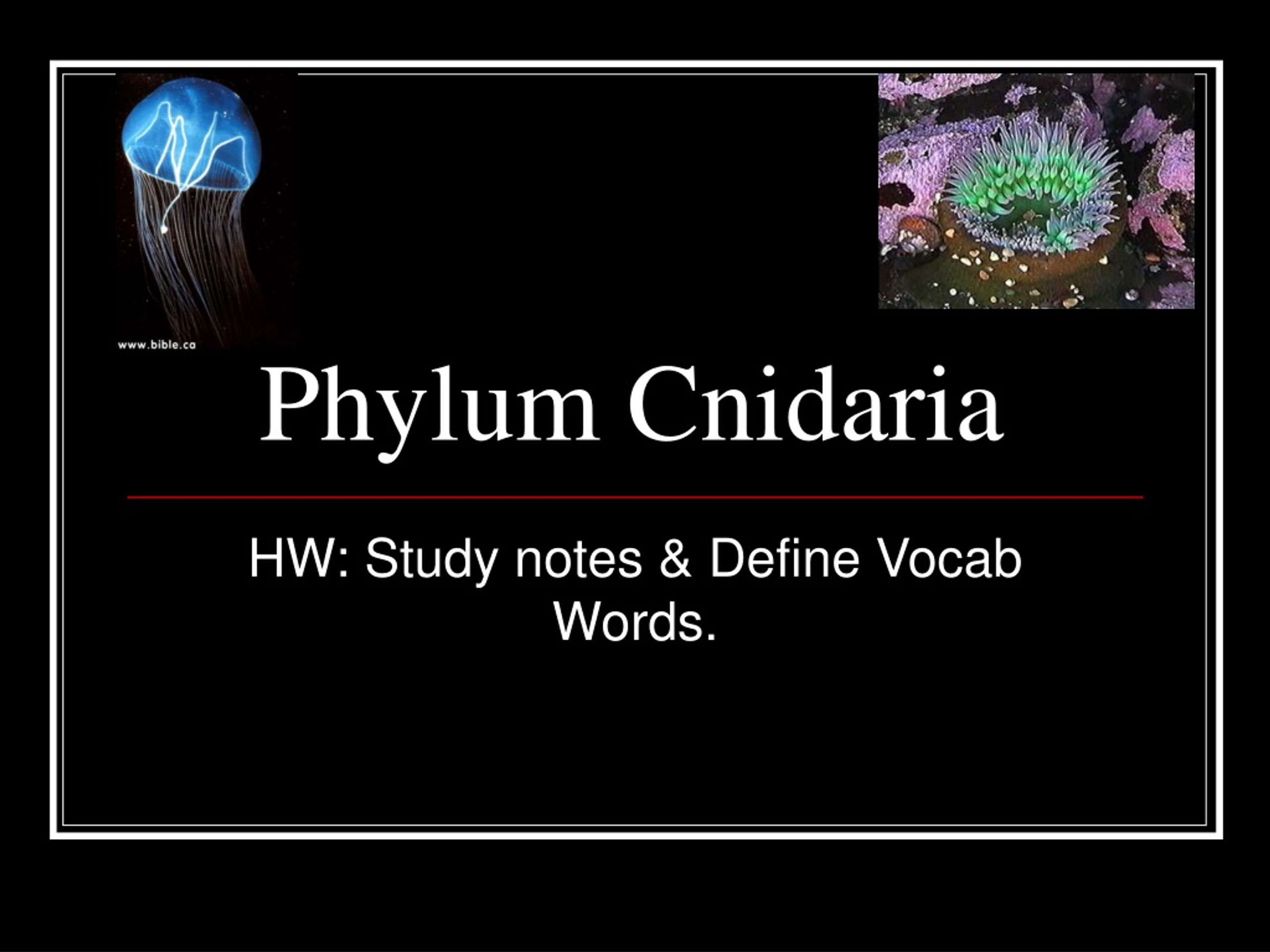
Phylum Cnidaria . HW: Study notes & Define Vocab Words. Intro to Cnidarians. How do you say it???? Say it with me now: (ni DARE ee uh) Practicing saying this when you are with your friends so you sound smart. What are cnidarians? Examples: Jellyfish & Sea Anemones
Phylum Cnidaria - slide 1
01 / 12Phylum Cnidaria
1 / 17

Télécharger la présentation

Phylum Cnidaria
Une image / un lien ci-dessous est fourni (tel quel) pour télécharger la présentation

Politique de téléchargement : le contenu du site vous est fourni TEL QUEL pour votre information et votre usage personnel ; il ne peut être vendu, concédé sous licence ni partagé sur d’autres sites sans l’accord de son auteur.Le contenu vous est fourni TEL QUEL, pour votre information et votre usage personnel uniquement. Téléchargez la présentation en cliquant sur ce lien. Lors du téléchargement, si vous ne parvenez pas à télécharger une présentation, l’éditeur a peut-être supprimé le fichier de son serveur.Pendant le téléchargement, si vous ne parvenez pas à obtenir une présentation, le fichier a peut-être été supprimé par l’éditeur.

F I N

Plus de contenu associé

Transcription de la présentation
  1. Phylum Cnidaria HW: Study notes & Define Vocab Words.

  2. Intro to Cnidarians • How do you say it???? • Say it with me now: (ni DARE ee uh) • Practicing saying this when you are with your friends so you sound smart. • What are cnidarians? • Examples: Jellyfish & Sea Anemones • Are there many species of cnidarians? • Yes, there are 10,000 different species!

  3. Body Structure • Like sponges, they have: • One body opening • Two cell layers • Unlike sponges: • Their cell layers are organized into tissues that have specific functions. • They have symmetry

  4. Body Structure, cont’d • The function of the two layers: • Outer Layer: protects internal body • Inner Layer: mostly for digestion

  5. Cnidarian Symmetry • Cnidarians are radially symmetrical. • Remember what that means???? • Radially symmetrical organisms can detect & capture prey from any direction. • This is especially helpful for the sessile & slow moving cnidarians. • Some cnidarians are aquatic floaters. • Others are sessile. • What’s that again????

  6. Feeding & Digestion • What’s a jellyfish look like? • They have long, stinging tentacles. • The tentacles have stinging cells called cnidocytes. (NI duh sites). • They also have nematocysts. • These are capsules that have threadlike tubes that contain poison & barbs.

  7. The nifty nematocyst • Nematocysts are like harpoons. • They are propelled by osmotic pressure (water pressure). • When a cnidarian is touched or otherwise stimulated water rushes into the nematocyst (by osmosis) and increases the water pressure, forcing the barb out of the nematocyst. • The force is so strong that the barb can penetrate a crab shell.

  8. Feeding & Digestion cont’d • After prey is hit with a nematocysts or cnidocytes (tentacles) the cnidarian brings it to its mouth (it’s only opening). • It then eventually makes it’s way to the gastrovascular cavity. • Cells in the gastrovascular cavity secrete digestive enzymes to break down the captured prey. • Any undigested material is then expelled through the mouth. Yummy.

  9. Response to stimuli • Cnidarians have a primitive nervous system known as a nerve net. • These specialized cells can cause contractions of muscle-like tissue. • The movement of tentacles during prey capture is a result of these contractions.

  10. Types of organ systems • As we’ve mentioned Cnidarians have: • A primitive digestive system • A primitive nervous system • They do not have: • A circulatory system • A respiratory system • Excretory system • So while they are more complex than a sponge, they are still not very complex creatures.

  11. Comparison of Sponges & Cnidarians

  12. Vocabulary Review -- HW • Define the following words using your notes: • Radially Symmetry • Sessile • Cnidocyst • Nematocyst • Gastrovascular cavity • Nerve net