Download
1 / 10
100 likes | 258 Vues
Delve into the intricacies of the Spanish preterite tense, essential for expressing completed past actions. Discover key phrases, the structure of regular and irregular verbs, and how to form them correctly. Learn about the significance of time indicators (e.g., yesterday, last July) and how they influence meaning. This guide also covers unique orthographic changes for specific verb endings and straightforward conjugation patterns. Enhance your understanding of ser, ir, hacer, and more, while practicing with engaging examples.

E N D
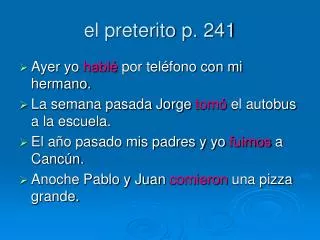
El Preterito U1E1 Past tense. refers to specific, completed past actions Key Phrases: Certain time (last night, yesterday at 4:00, last July 4th) certain number of times (once, 3 times) Structure: Simple tense verb stem + ending
The Preterite Tense • Fixed point in time • I called you at 3:00 • Specific number of actions • I called you five times • Enclosed amount of time • I worked for eight hours.
Sometimes time is implied rather than stated. • I went to John’s party. • We ate at McDonald’s. • The meeting was boring • In the first 2 sentences, it is implied that the action happened once. • in the 3rd, we can assume that the meeting, from beginning to end, was boring.
Forming regular verbs in the preterite. • -ar verbs. Drop the –ar and add the following endings • hablar(I spoke, you spoke, he spoke)
-er and –ir verbs. Drop the –er or –ir and add the following endings –They are exactly the same!— • comer (I ate, you ate, he ate) • vivir(I lived, you lived, he lived)
Orthographic Changes in Regular Verbs (Crazy yo’s!) • verbs ending in gar; insert u before the e • yollegué • verbs ending in car; change c to qu • yobusqué • verbs ending in zar; change z to c. • yoalmorcé
VerbosIrregulares (grupo 1) • ser, ir, hacer are unpredictable and must be memorized. • ser and ir have same conjugation; use context clues to determine the appropriate word.
yo tú él nosotros ellos Irregular conjugations: ir, ser, hacer ser ir hacer fui fui hice fuiste fuiste hiciste fue fue hizo fuimos fuimos hicimos fueron fueron hicieron
yo tú él nosotros ellos Irregular conjugations dar, ver • dar and ver have –er/-ir endings but no accents! dar ver di vi diste viste dio vio dimos vimos dieron vieron