Fair Division in Daily Life: Mathematics Behind Equal Allocation
Discover the mathematics of fair division, focusing on practical algorithms for equitable resource distribution. This study explores methods like Amidakuji and the Selfridge-Conway Algorithm, which help resolve issues such as cake division among two or more people while ensuring fairness. It addresses various scenarios, from divorce settlements to resource allocation in airport traffic management, emphasizing the importance of proportional division. Learn how cutting techniques and valuations guide individuals in making choices that uphold fairness in sharing resources.

Fair Division in Daily Life: Mathematics Behind Equal Allocation
E N D
Presentation Transcript
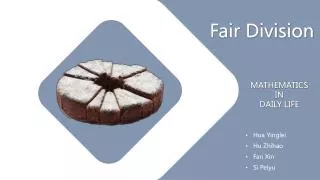
Fair Division LOGO MATHEMATICS IN DAILY LIFE • Hua Yinglei • Hu Zhihao • Fan Xin • Si Peiyu
Assign Tasks Amidakuji Tasks Divide Tasks
How to divide a cake? --two persons Taking more things into consideration
Proportional Division P2 P1 P1 P2 P3
The Final Reduction Algorithm • Person who is the last one to cut the 1/n part will get this part of cake • Everyone has two choices: • Give the cut-cake to the next one directly • Cut down the size of the piece into 1/n according to his valuation
If anyone cuts the cake into piece which is smaller than 1/n of the cake deliberately…… • If anyone gives a piece of cake which is bigger than 1/n of the cake to someone else deliberately……
Selfridge-Conway Algorithm A1 A21 A22 A A23 C B • P1 divides the cake into three pieces • he considers of equal sizes • …… P2 P1 P3
2 3 1 Applications and Conclusions Fair division is the problem of dividing a set of goods between several people, such that each person receives his/her due share. Distribution of social welfare Divorce settlements Airport traffic management and so on