
SlideServe
Menu
Préférences
© SlideServe · v2026

Some Impacts of Atmospheric Aerosols

evania avatar
14 diapositives · 672 Views · May 26, 2012

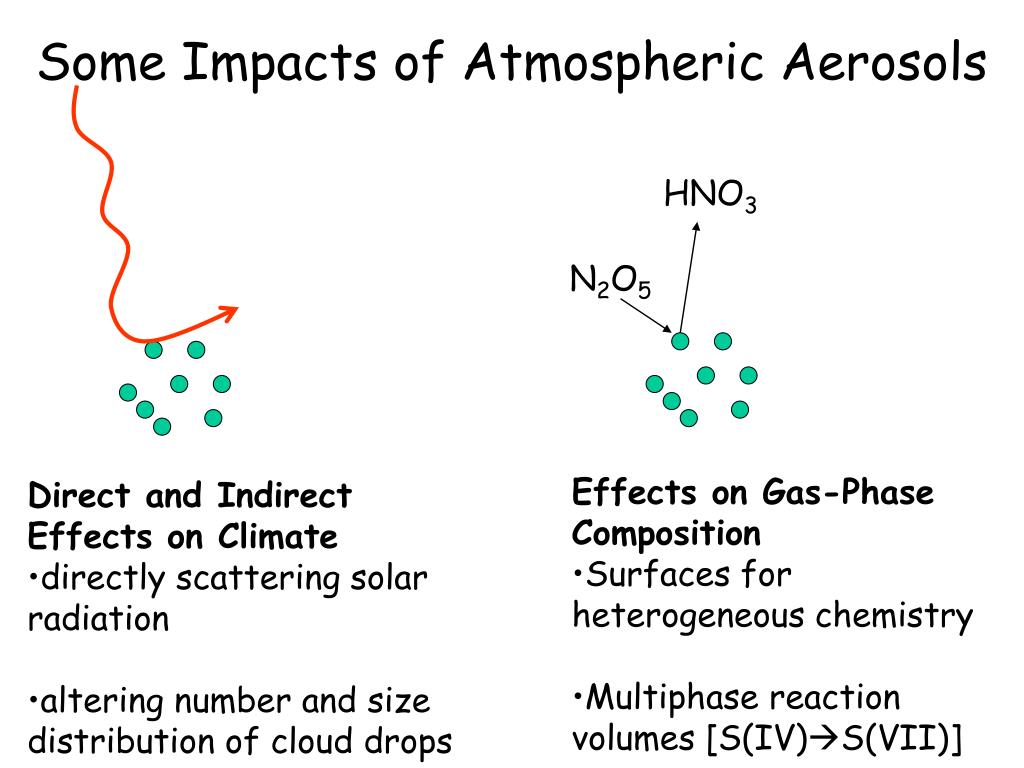
Some Impacts of Atmospheric Aerosols. HNO 3. N 2 O 5. Effects on Gas-Phase Composition Surfaces for heterogeneous chemistry Multiphase reaction volumes [S(IV) S(VII)]. Direct and Indirect Effects on Climate directly scattering solar radiation
Some Impacts of Atmospheric Aerosols - slide 1
01 / 14Some Impacts of Atmospheric Aerosols
1 / 17

Télécharger la présentation

Some Impacts of Atmospheric Aerosols
Une image / un lien ci-dessous est fourni (tel quel) pour télécharger la présentation

Politique de téléchargement : le contenu du site vous est fourni TEL QUEL pour votre information et votre usage personnel ; il ne peut être vendu, concédé sous licence ni partagé sur d’autres sites sans l’accord de son auteur.Le contenu vous est fourni TEL QUEL, pour votre information et votre usage personnel uniquement. Téléchargez la présentation en cliquant sur ce lien. Lors du téléchargement, si vous ne parvenez pas à télécharger une présentation, l’éditeur a peut-être supprimé le fichier de son serveur.Pendant le téléchargement, si vous ne parvenez pas à obtenir une présentation, le fichier a peut-être été supprimé par l’éditeur.

F I N

Plus de contenu associé

Transcription de la présentation
  1. Some Impacts of Atmospheric Aerosols HNO3 N2O5 • Effects on Gas-Phase Composition • Surfaces for heterogeneous chemistry • Multiphase reaction volumes [S(IV)S(VII)] • Direct and Indirect Effects on Climate • directly scattering solar radiation • altering number and size distribution of cloud drops

  2. Secondary Particles SO2 +OH (+H2O)H2SO4 Secondary Mass Growth Primary particles RH + OHRCOOH Some Sources of Aerosol Particles

  3. Aerosol Particle Size: Diameter vs. Effective Diameters For many particles, spherical geometry good assumption. “Diameter” has physical meaning Spherical?

  4. rp Some Effective Diameters Relation to aerodynamic diameter and other physical properties of particle not well understood for fractal like soot particles. rp Aerodynamic Diameter Electric Mobility Diameter Same terminal falling speed in air as a particle with density 1g/cm3 and radius rp Same trajectory in calibrated electric field as a spherical singly charged particle with radius rp

  5. Number Concentration (cm-3) 0 1.0 0.5 Diameter (m) Bean Counting: Aerosol Size Distributions 0.005 0.05 0.3 1.0 0.001 0.02 0.1 0.6 10 • Problems • Information lost at small sizes due to large size range • Comparing particle concentrations in different bins marred by varying bin size • Area under curve is not proportional to total particle number concentration

  6. Visual Representation of Particle Size Distributions Ni/Dpi vs. Dp Ni/log(Dpi) vs. Log(Dp) Area under both curves yields Ntotal But dN/dlogDp vs. logDp is more informative

  7. dN/dlogDp only. Why? Questions • The figure shows various representations of the same aerosol size distribution. Under which curve(s) is the area equal to the total particle number concentration? • dN/dDp (blue) • dN/dlogDp (green) • dN/dlnDp (red)

  8. --Assuming spherical geometry and dDp0 Area dS(Dp) = Dp2n(Dp)dDp Number dV(Dp) = (/6)Dp3n(Dp)dDp Area, Volume-Mass Distributions Heterogeneous and multiphase reaction rates depend on surface area or volume, respectively. Gravitational settling rates depend on mass and air quality standards are mass-based.

  9. Questions • What are the units of Stot and Vtot? • How is the mass distribution function calculated? • What is the relevant property (area, volume, mass) for the following aerosol particle processes: • Scavenging of HNO3 by mineral dust • Acidification of aerosols by gas-phase H2SO4 • Light scattering efficiency • Amount of Fe deposited to ocean by dust

  10. Smoothed Vertical Profiles of Aerosol Number Concentrations—(highly variable) Boundary layer: 10 – 105 cm-3 range in number concentration Free Troposphere: ~100-300 cm-3 on average

  11. Common Modes of Atmospheric Aerosol Distributions

  12. Typical Number Distribution for Urban Aerosols Solid line: what would be observed, composed of 3 modes Dotted/Dashed lines: Two common parameterizations • Junge Distribution (dashed line) is a power law. Has some useful properties but requires care. • Log-Normal distribution (dotted line) is most often used

  13. Continental and Marine Number Distributions Lower numbers in these regions relative to urban aerosols, especially in the nucleation mode. Dominant accumulation mode indicative of “aged” particles. Giant aerosols over ocean dominated by sea salt.

  14. 2 and ? The Log-Normal Distribution • The Log-normal distribution • Bell-curve shape in log space • The familiar normal (Gaussian) distribution • Bell-curve shape in linear space • 68% of variance about mean ( ) captured by 2 (width)