Download
1 / 20
200 likes | 315 Vues
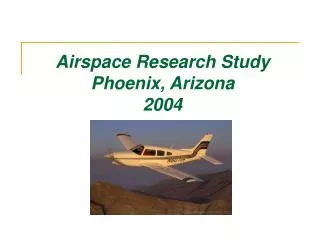
This 2004 research project in Phoenix, Arizona, aimed to improve operational safety in local airspace by understanding practice area usage across six airports (CHD, FFZ, IWA, SDL, DVT, P19). Through surveys distributed to various flight schools and FBOs, key data was gathered on primary practice areas, altitudes, and collision avoidance. The study highlighted findings on transitioning patterns and proposed recommendations for increased awareness, better communication, and operational improvements. Continued bi-annual research is recommended for ongoing safety enhancements in the Valley.

E N D
Airspace Research Study Phoenix, Arizona 2004
Objective • Goal: • To advocate improved operational safety through enhanced understanding of surrounding practice area usage • Valley-wide distribution of study results and recommendations • Continued annual to bi-annual research for continued improvement • Airports Studied: CHD, FFZ, IWA, SDL, DVT, & P19 • General Focus: Northeast, Northwest, Southeast, & Southwest practice areas
Research Development • Surveys distributed to various FBO/ Flight schools Valley-wide contained questions involving: • Primary practice area usage • Altitude utilization • Transitions • Collision Avoidance • Data received from surveys implemented into presentation **All information, charts, and graphs are based only on submitted surveys, accuracy varies
Average Aircraft within Practice Areas
Maximum Aircraft within Practice Areas
Primary Practice Areas by Airport • IWA: Southeast & Southwest • CHD: Southeast & Southwest • FFZ: East, Northeast, Southeast, & Southwest • SDL: Northeast, Southeast, & Southwest • DVT: Northwest (primary), Northeast (secondary), Southeast, Southwest (occasionally)
IWA: Transitioning To & From • Helicopter (1 school’s info): • Direct into SE practice area and direct to return to IWA at 500’ AGL • Fixed Wing (2 school’s info): • SE and SW practice area average daily transitions (2 schools): • From IWA-practice area transition points: • Over Pegasus • Between ‘Mr. Volcano’ & Santan Mountains • “Gap” of the Santan Mountains • Rittenhouse to Renaissance Festival • From practice area-IWA • Same positions as transitioning outbound • Altitudes: • Outbound altitudes: 4,000 MSL and above • Inbound altitudes: 3,500 MSL
CHD: Transitioning To & From • Fixed Wing (1 school/FBO info): • From CHD to Practice area: • Headings between 100-220 degrees • Practice area to CHD: • 4 NM directly south of field • 4 NM directly east of field • Altitudes: • Inbound altitudes: 2,500-3,500 MSL • Outbound altitudes 2,500-3,500 MSL
FFZ: Transitioning To & From • Fixed wing: (2 school’s info): • From FFZ- NE practice area: • Direct to practice area • Either side of Red Mt. to practice area • Direct Fountain Hills • Return over same points • From FFZ-SE practice area (Apache Junction) • Directly east from FFZ to canal and U.S. 60 at 3,000 MS • Altitudes: • Outbound altitudes: 3,500 MSL and above/ 4,500 MSL • Inbound altitudes: 3,000 MSL/ 4,500 MSL
SDL: Transitioning To & From • Fixed wing (1 school’s info): • From SDL-NE/SE practice areas: • NE and SE via usary Pass/ Apache Junction • From SDL-SW practice area: • Via Class Bravo transition or SE practice area • Inbound and Outbound altitudes: • 3,500 MSL- 6,500 MSL
DVT: Transitioning To & From • Fixed wing (2 schools): • From DVT-all practice areas: • All directions from DVT • 25L/R: west of I-17, then NW or W to shooting range, orchards, or towards Luke AFB Aux. Fields • 7L/R: N-NW over Cave Creek dam, bend in Carefree HWY, or NE-E toward Pinnacle Peak • Inbound from practice area- DVT: • Same as outbound reference points • Outbound and Inbound altitudes: • 3,000- 5,500 MSL
Projected Growth of Aircraft in 5 Years • Goodyear: Remain the same • Scottsdale: 50% increase • Gateway: 10%-50% increase fixed wing/ 50% increase rotor • Deer Valley: 50% increase • Chandler: 10% increase • Falcon: 30% increase
Extended Collision Avoidance Suggestions • Utilization of higher altitudes • Operate further out in each practice area • Communication on proper frequencies • Coordination of company aircraft • Possibility of VFR flight following from ABQ center or PHX approach • Additional TCAS equipped aircraft • Spreading awareness of operations to all flight schools/FBO Valley wide
Getting Involved • Develop awareness of the AFTW • Distribute discovered research • Hand out additional surveys to other facilities