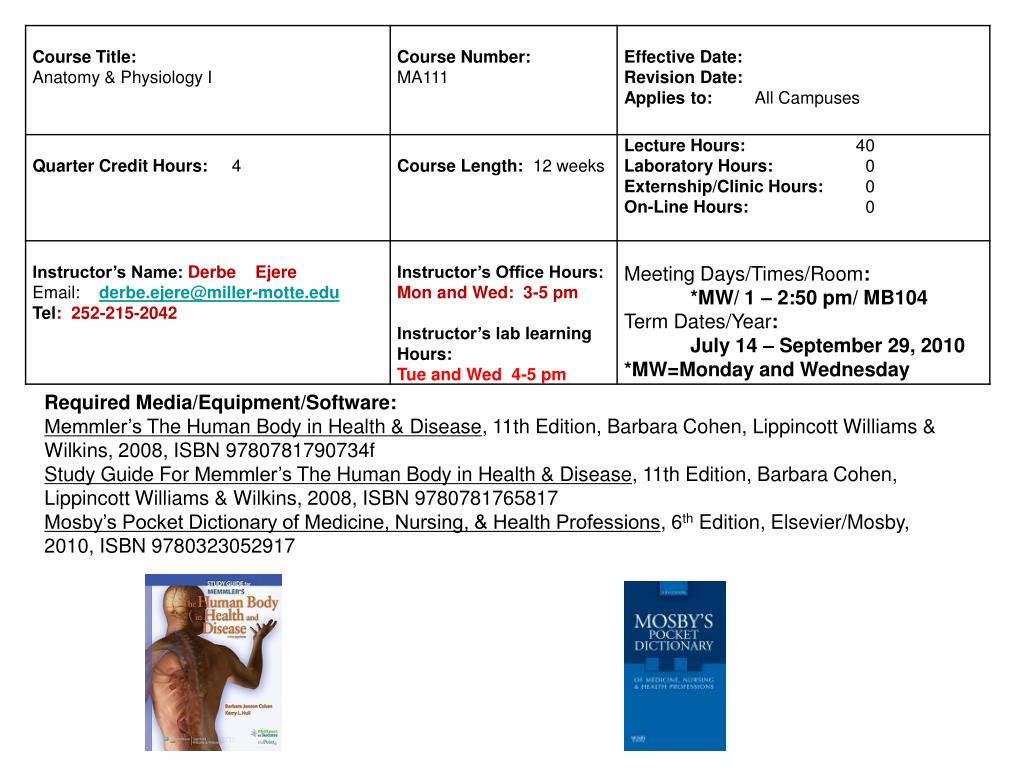
Required Media/Equipment/Software: Memmler’s The Human Body in Health & Disease, 11th Edition, Barbara Cohen, Lippincott Williams & Wilkins, 2008, ISBN 9780781790734f Study Guide For Memmler’s The Human Body in Health & Disease, 11th Edition, Barbara Cohen, Lippincott Williams & Wilkins, 2008, ISBN 9780781765817 Mosby’s Pocket Dictionary of Medicine, Nursing, & Health Professions, 6th Edition, Elsevier/Mosby, 2010, ISBN 9780323052917
Grading and Evaluation: Final Grades will be determined by: Grading Scale: Class Participation 10% 90-100% A Homework/Assignments 20% 80-89% B Quizzes 20% 70-79% C Examinations 30% 00-69% F Projects 20% Total 100%
Memmler’sThe Human Body in Health and Disease11th edition Anatomy & Physiology Chapter 1 Organization of the Human Body
The study of the human body • Anatomy – The study of the structure of the body • Physiology – The study of the function of the body • Understanding the normal body is basis for analyzing disease • Pathology – The study of disease processes in the human body
Levels of Organization:
Protection, support, and movement Integumentary (skin) Skeletal Muscular Coordination and control Nervous Endocrine Circulation Cardiovascular Lymphatic (immune) Nutrition and fluid balance Respiratory Digestive Urinary Production of offspring Reproductive 11 Body Systems
Checkpoint 1-1: In studying the human body, one may concentrate on its structure or function. What are these two studies called?
Integumentary System • Structure: - Includes skin, hair, nails, sebaceous (lubricating) and sweat glands • 2 layers – dermis & epidermis • 3rd layer - hypodermis • Function: • insulates, protects, temperature regulation, water regulation
Skeletal System • Structure: • Composed of bones, cartilage, joints • Function: • provides support/body framework • act as levers for movement • manufactures blood cells in red bone marrow • yellow marrow stores fat
Muscular System • Structure: • Consists of muscle fibers are arranged in bundles(fasciae), tendon sheaths, and bursae • Functions: • Skeletal (Voluntary): creates and limits movement • Smooth (Involuntary): moves food along the digestive tract, circulates blood • Cardiac: involuntary and causes heart contraction
Nervous System • Structure: • Composed of Brain, spinal cord, cranial nerves, peripheral nerves • Function: - controls and regulates all other systems of the body: receives internal and external stimuli from receptors & special senses, interprets stimuli and directs body’s response
Central Nervous System
Endocrine System • Glands produce hormones that regulate body activities such as growth and reproduction • Works with the nervous system through the hypothalamus of the brain to control and coordinate other body systems.
Cardiovascular System • Structure: • Consists of heart, arteries, veins, capillaries • Function • Circulates blood to and from the cells of the body
Lymphatic System • Structure: • Lymph nodes, tonsils, thymus gland, spleen, lymphatic vessels • Function: • Drains tissue spaces of excess interstitial fluid • Absorbs fats from the intestines and carries them to the blood • Protects the body from disease
Respiratory System • Structure: • Consists of nasal cavities, pharynx, larynx, trachea, bronchi, and lungs • Function • Brings oxygen to and eliminates carbon dioxide from the blood
Digestive System • Structure: • Consists of mouth, esophagus, stomach, small intestines, large intestines, liver and pancreas • Function: • Absorbs nutrients from food and eliminates indigestible wastes
Urinary System • Structure: • Two kidneys, two ureters, the bladder and urethra • Function: • Rids the body of waste products and excess water
Reproductive System • Women – ovaries, uterine tubes, uterus, vagina • Men – testes, vas deferens, seminal vesicles, prostate gland, penis, urethra • Allows for the process of conception, pregnancy and birth
Metabolism • Metabolism includes all life sustaining reactions that go on in the body • Consists two types of activities: • Catabolism – complex substances broken down into simpler compounds to deliver energy • Anabolism – the building phase of metabolism (for growth, tissue repair, function) • ATP – adenosine triphosphate - energy unit the body uses
Homeostasis • Maintenance of the internal environment of the body • Body temperature, body fluids, heart rate, blood pressure, etc must be kept within set limits to maintain health This steady state within the organism is called Homeostasis • Homeostasis is maintained through balance of intracellular and extra cellular fluids and a series of feedback loops
Fluid balance • Extracellular fluid: • Transport nutrients into and out of the cell • It includes all body fluids outside the cells • Example: blood, interstitial fluid • Intracellular fluid: • Contained within the cell
Feedback • Is a control system based on information returned to the source • Negative Feedback Loop – most body systems are regulated this way • An action causes the body to reverse the trend of that action • Examples include temperature regulation: Body temperature rises, alerting the brain, causing sweating and other cooling mechanisms • Positive Feedback Loop • An action produces more of the same action • Examples include childbirth: stretching the uterus causes contraction of the uterus causes stretching…
Comparison of positive and negative feedback.
Basic Reference Systems of Bodily Organization • Directions • Planes • Body Cavities
Directions • Superior • Inferior • Anterior (ventral) • Posterior (dorsal) • Cephalad (Cranial) • Medial • Lateral • Proximal • Distal •What is the scientific name for the position in which this subject is standing?
Planes • Median (midsagittal) plane – divides body down the middle into left and right halves • Sagittal – any plane parallel to the midsagittal plane – SIDEWAYS • Horizontal (transverse) plane – divides the body into top and bottom halves • Frontal (coronal) plane – divides the body into front and back halves • Longitudinal section – cut long ways • Transverse section – cut across the middle
•Which plane divides the body into superior and inferior parts? •Which plane divides the body into anterior and posterior parts?
Tissue Sections • Cross section • Longitudinal (transverse) section • Oblique section
Cavities • Dorsal Cavity: contains organs of the nervous system • Cranial Cavity • Spinal cavity • Ventral Cavity: contains organs involved in maintaining homeostasis • Thoracic cavity • Abdominopelvic cavity
Definitions • Viscera – any organ • Peritoneum – membrane lining of the abdominal cavity and abdominal organs • Parietal – walls of a cavity • Visceral – referring to an organ • Interstitial fluid – the fluid between cells