Understanding Metric Conversions and Scientific Notation in Biology
40 likes | 185 Vues
In this lesson, students will learn to use conversions and scientific notation to accurately convey numerical (quantitative) data crucial in biology. Key activities include solving problems related to metric unit conversions, comparing magnitudes, and practicing scientific notation. Students will engage in warm-up exercises and collaborative comparisons, solidifying their understanding of how to express measurements and data in a precise scientific format. This foundational knowledge is essential for effective communication in biological studies and experiments.


Understanding Metric Conversions and Scientific Notation in Biology
E N D
Presentation Transcript
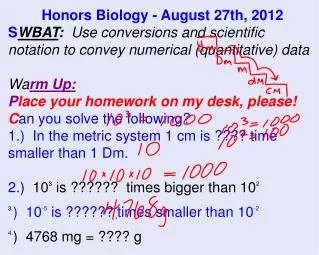
Honors Biology - August 27th, 2012 SWBAT: Use conversions and scientific notation to convey numerical (quantitative) data Warm Up: Place your homework on my desk, please! Can you solve the following? 1.) In the metric system 1 cm is ???? time smaller than 1 Dm. 2.) 103 is ?????? times bigger than 102 3.) 10-5 is ?????? times smaller than 10-2 4.) 4768 mg = ???? g
1000 1 1600 14000 .250 .109 Comparisons: 56cm < 6m 7g > 698mg
kg mL km cm mm m mg L g 2 5000 160 104,000 .198 2.5 .075 65000 4.8 5600 .5 63 560 .12 .8