Understanding Linear Scales in Measurement Systems
Learn how to interpret linear scales in measurement systems, correct scale ratios, and convert measurements accurately. Practice exercises included.

Understanding Linear Scales in Measurement Systems
E N D
Presentation Transcript
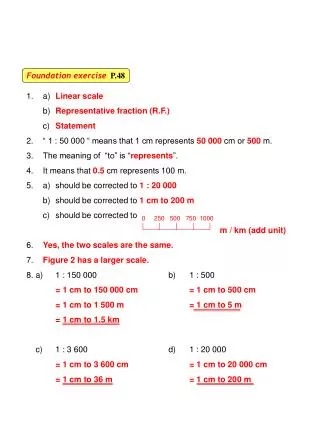
Foundation exerciseP.48 1. a) Linear scaleb) Representative fraction (R.F.)c) Statement2. “ 1 : 50 000 “ means that 1 cm represents 50 000 cm or 500 m.3. The meaning of “to” is “represents”.4. It means that 0.5 cm represents 100 m.5. a) should be corrected to 1 : 20 000 b) should be corrected to 1 cm to 200 m c) should be corrected to 0 250 500 750 1000 m / km (add unit)6.Yes, the two scales are the same.7.Figure 2 has a larger scale.8.a) 1 : 150 000 b) 1 : 500= 1 cm to 150 000 cm = 1 cm to 500 cm = 1 cm to 1 500 m = 1 cm to 5 m = 1 cm to 1.5 kmc) 1 : 3 600 d) 1 : 20 000= 1 cm to 3 600 cm = 1 cm to 20 000 cm = 1 cm to 36 m = 1 cm to 200 m
9.a) 1 cm to 250 m b) 1 cm to 0.5 km = 1 cm to 25 000 cm = 1 cm to 500 m = 1 : 25 000 = 1cm to 50 000cm = 1 : 50 000c) 0.5 cm to 150 m d) 1 cm to 2.4 km= 1 cm to 300 cm = 1 cm to 2 400 m = 1 cm to 30 000 cm = 1 cm to 240 000 cm = 1 : 30 000 = 1 : 240 00010.a) 1 : 25 000 b) 1 : 4 0000 250 500 750 1000 m 0 40 80 120 160 200 m11.a) The first part of the linear b) The first part of the linear scale is 1 cm. scale is 2 cm. It represents 150 m of ground It represents 2 km of ground distance. distance.∴ 1 cm to 150 m ∴ 2 cm to 2 km = 1 cm to 15 000 cm = 1 cm to 1 km = 1 : 15 000 = 1 : 100 00012.A13. a) Large b) Small