Download
1 / 17
170 likes | 297 Vues
This study, conducted by Ellen van der Velden and Saskia van der Kam in June 2008, addresses the high defaulter rates in Ambulatory Therapeutic Feeding Programs (ATFP). It identifies modifiable factors that could decrease defaulting rates through a combination of quantitative data and qualitative insights from interviews in South Sudan. The findings show that defaulters share similar characteristics with non-defaulters, while the barriers to retention include personal and social perceptions, insecurity, and indirect costs. Recommendations focus on enhancing communication, improving access, and streamlining patient flow.

E N D
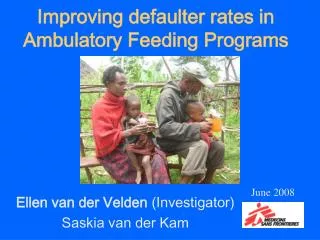
Improving defaulter rates in Ambulatory Feeding Programs Ellen van der Velden (Investigator) Saskia van der Kam June 2008
Objectives • Identify key factors modifiable by MSF that would decrease defaulting in ambulatory feeding programs (ATFP)
Methods • Analysis of available quantitative program data • Analysis of qualitative information from interviews and observation (all under program field conditions)
Methods Plus • Some defaulter interviews in South Sudan
Results Quantitative methods • Defaulters do not differ from non-defaulters in terms of • Age • Gender • Weight on admission • Height on admission • Irregular attendance not associated with defaulting • Defaulting occurred regardless of last recorded W/H status
Qualitative methods Behaviour analysed from three perspectives • Personal perception of likely consequences (Behaviour belief) • Social norms (Normative belief) • Personal perception of ability to act (Control belief)
Result Personal and Social Beliefs • Caretakers perceived their child was sick, not malnourished • Caretakers lacked an understanding of the purpose of the nutritional program • Social beliefs/norms have a limited impact on defaulting rates
Results Control Beliefs Security • Insecurity related to traveling was identified as a barrier • Influence of insecurity not measurable Costs • Direct costs (money) seen as low • Indirect costs are considerable (e.g. long waiting time, travel time, opportunity costs)
Distance as barrier to completion of treatment % Cured/ defaulter
Limitations of study • Conducted under field conditions while providing technical support to programs • Limited access to beneficiary perspectives
Conclusion Many obstacles identified are modifiable • Mother’s understanding of program aims • Geographical access • Patient waiting times and clinic opening • Food stock ruptures
Recommendations • Improve MSF- caretaker communication (personal and community level) • Outreach indispensable for retention and tracing • Decentralization to increase access • Efficient patient flow
Acknowledgements • Field teams and beneficiary participants in the 5 programs • Royal Tropical Institute (KIT), Amsterdam