Napoleon's Ambitious Rise: Triumphs and Challenges in Europe
This overview explores Napoleon Bonaparte's extraordinary ascent to power, marked by military successes and strategic reforms including the Concordat and Napoleonic Code. By 1812, he dominated Europe through decisive victories and territorial expansion, despite facing rising nationalism and brutal challenges like the Russian campaign. His ambitious policies and the consequent repercussions shaped Europe, culminating in his final defeat at Waterloo in 1815, and the Congress of Vienna's efforts to establish lasting peace. The era significantly influenced modern governance and the future of European nationalism.


Napoleon's Ambitious Rise: Triumphs and Challenges in Europe
E N D
Presentation Transcript
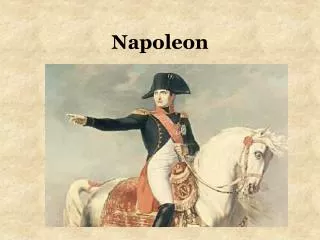
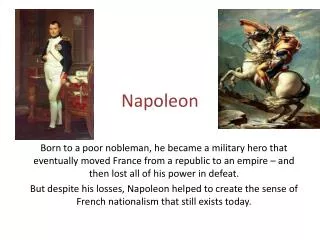
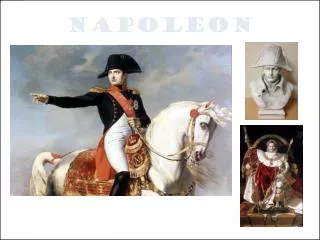
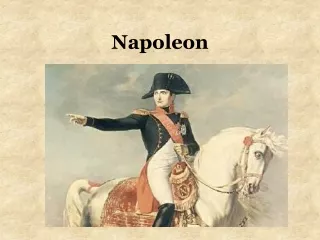
Napoleon Images from Google.com Ms. Ramos
Napoleon’s Rise to Power • Ambitious • Military successes • Plebiscite Ms. Ramos
Napoleons Reforms • Improved economy • Public school system • Concordat • Napoleonic Code Ms. Ramos
How Dominate Europe by 1812 • Defeated Europeans by moving lg armies, taking risks, & willing to suffer losses Ms. Ramos
Annexed some lands • Netherlands, Belgium, Italy • Alliances • Spain, Russia, Prussia • Continental System • Closed Euro ports to UK goods Ms. Ramos
Challenges to Napoleon’s Empire • Nationalism in Euro states • Guerrilla warfare in Spain Ms. Ramos
Disaster in Russia • Austria wants revenge • Russian winter • Scorched-earth policy Ms. Ramos
Napoleon’s Impact • Spread ideas of nationalism • Helped US expansion- Louisiana Purchase • Abolished Holy Roman Empire– creating Germany Ms. Ramos
Napoleon in Exile on Elba Ms. Ramos
Napoleon’s Defeat at Waterloo(June 18, 1815) Duke of Wellington Prus. General Blücher Ms. Ramos
Napoleon on His Way to HisFinal Exile onSt. Helena Ms. Ramos
Congress of Vienna Goal • Create lasting peace in Europe by est balance of pwr & protect monarch system Ms. Ramos
Congress of Vienna Outcomes • Balance of pwr that lasted 100 yrs, but failed to anticipate nationalism Ms. Ramos