Download
1 / 17
170 likes | 303 Vues
The Global Names Architecture at the Asian Regional Meeting in 2009 focused on improving access to taxonomic data. With over 190 million records and 5 million distinct taxon names, the challenges of using names as identifiers were discussed. The workshop emphasized the importance of cataloging, taxonomic synonomy, and the value of taxonomic databases. Key objectives included developing a global taxonomic infrastructure and enhancing data quality through tools and services. Participants were invited to consider how these advancements can be integrated into national and regional biodiversity initiatives.

E N D
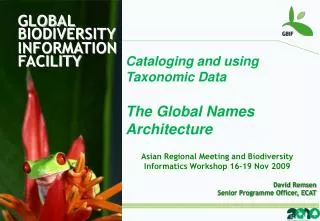
INFORMATIONFACILITY Cataloging and using Taxonomic Data The Global Names Architecture GLOBALBIODIVERSITY Asian Regional Meeting and Biodiversity Informatics Workshop 16-19 Nov 2009 David Remsen Senior Programme Officer, ECAT
Enable access to information about species Scientific nameslabel that information
We use names to retrieve species information 190M records – 5M distinct “taxon” names
Names make poor identifiers Information science & authority files address this.
…even when properly spelled Information science & authority files address this.
Nomenclatural Databases Provide original orthography and tie names to their originating publications
Taxonomic Catalogues Taxonomic Status Name of Taxon Classification Circumscription Taxonomic Synonyms
Terminology • Catalogues • Monographs • Regional Flora/Fauna • Primary Sources • Inventories/Species Lists • Secondary Sources • Nomenclators • No Taxonomy at all • Scope • Taxonomic • Regional • Thematic http://code.google.com/p/gbif-ecat/wiki/ChecklistDefinition
Global Names Architecture Idea • Mobilise • Develop global taxonomic infrastructure • National, Regional, Global, Thematic • Index • Create a Global Library of Taxonomic Resources • Link • Create a single authoritative “dictionary” of names • Use / them • Develop tools and services that use these resources to facilitate integration and make life easier.
Dynamic Index of Checklists 2010 Q1 Release
BuildNameDictionary Services Enables Taxonomic Catalogues to be used to improve data quality in collections
Save Time • Improve Accuracy • Organise species data • Automate manual tasks BuildTaxonomicName Services Organised/Up-to-Date Unorganised/out-of-date
New Processes/Technologies New Derived Products Create new checklists
Applied to data access and integration Use species lists to filter data retrieval
Questions • Can you benefit from these sorts of services? • Do you want a national Checklist Catalogue? • Should GBIFS focus on providing software for making Checklist Catalogues or services for using them?