The Future of Mobile App Development: Why Choose Android?
Discover the dynamic landscape of mobile app development and why Android is at the forefront. The mobile platform is shaping the future, with smartphone ownership growth projected in double digits. The job market is thriving, with employers actively seeking Android developers. Android's accessibility, low learning curve for students familiar with Java, and the ability to distribute apps easily make it an attractive choice. Explore the evolution of Android and its impact on mobile technology, and why this platform is ideal for aspiring developers.

The Future of Mobile App Development: Why Choose Android?
E N D
Presentation Transcript
Android Overview Shashank Kailash Gajbhiye
Why Mobile App Development? • The fact that we can! Only a few years ago you had to be in the Motorola inner circle to do it! • Mobile platform is the platform of the future • Double-digit growth in world-wide smartphone ownership3 • Job market is hot • Market for mobile software surges from $4.1 billion in 2009 to $17.5 billion by 20121 • 2010 Dice.com survey: 72% of recruiters looking for iPhone app developers, 60% for Android1 • Dice.com: mobile app developers made $85,000 in 2010 and salaries expected to rise2 • Students (and faculty!) are naturally interested!
Why Android? • A lot of students have them • 2010 survey by University of CO1: 22% of college students have Android phone (26% Blackberry, 40% iPhone) • Gartner survey2: Android used on 22.7% of smartphones sold world-wide in 2010 (37.6% Symbian, 15.7% iOS) • Students already know Java and Eclipse • Low learning curve • CS0 students can use App Inventor for Android
Why Android? • Transferring app to phone is trivial • Can distribute by putting it on the web • Android Market for wider distribution • It’s not 1984
Types of Android Devices
Android-Powered Microwave By Touch Revolution – at CES 2010
Brief History • 1996 • The WWW already had websites with color and images • But, the best phones displayed a couple of lines of monochrome text! • Enter: • Wireless Application Protocol (WAP) – stripped down HTTP for bandwidth reduction • Wireless Markup Language (WML) – stripped down HTML for content
Brief History • Many issues (WAP = “Wait And Pay”) • Few developers to produce content (it wasn’t fun!) • Really hard to type in URLs using the small keyboards • Data fees frightfully expensive • No billing mechanism – content difficult to monetize • Other platforms emerged • Palm OS, Blackberry OS, J2ME, Symbian (Nokia), BREW, OS X iPhone, Windows Mobile
Brief History - Android • 2005 • Google acquires startup Android Inc. to start Android platform • Work on Dalvik VM begins • 2007 • Open Handset Alliance announced • Early look at SDK • 2008 • Google sponsors 1st Android Developer Challenge • T-Mobile G1 announced • SDK 1.0 released • Android released open source (Apache License) • Android Dev Phone 1 released
Brief History cont. • 2009 • SDK 1.5 (Cupcake) • New soft keyboard with “autocomplete” feature • SDK 1.6 (Donut) • Support Wide VGA • SDK 2.0/2.0.1/2.1 (Eclair) • Revamped UI, browser • 2010 • Nexus One released to the public • SDK 2.2 (Froyo) • Flash support, tethering • SDK 2.3 (Gingerbread) • UI update, system-wide copy-paste
Brief History cont. • 2011 • SDK 3.0/3.1/3.2 (Honeycomb) for tablets only • New UI for tablets, support multi-core processors • SDK 4.0/4.0.1/4.0.2/4.0.3 (Ice Cream Sandwich) • Changes to the UI, Voice input, NFC Honeycomb Android 3.0-3.2 Ice cream Sandwich Android 4.0+
The Android Developer Website • http://developer.android.com/index.html • This should be your homepage for the next semester!
Distribution of Devices Data collected during a 14-day period ending on January 3, 2012
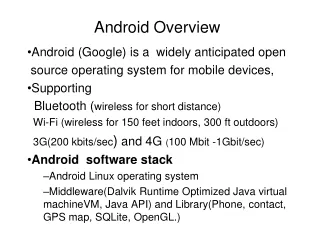
What is Google Android? • A software stack for mobile devices that includes • An operating system • Middleware • Key Applications • Uses Linux to provide core system services • Security • Memory management • Process management • Power management • Hardware drivers
Android Architecture More details at: http://developer.android.com/guide/basics/what-is-android.html
Mobile Devices: Advantages (as compared to fixed devices) • Always with the user • Typically have Internet access • Typically GPS enabled • Typically have accelerometer & compass • Most have cameras & microphones • Many apps are free or low-cost
Mobile Devices: Disadvantages • Limited screen size • Limited battery life • Limited processor speed • Limited and sometimes slow network access • Limited or awkward input: soft keyboard, phone keypad, touch screen, or stylus • Limited web browser functionality • Range of platforms & configurations across devices
Mobile Applications • What are they? • Any application that runs on a mobile device • Types • Web apps: run in a web browser • HTML, JavaScript, Flash, server-side components, etc. • Native: compiled binaries for the device • Often make use of web services
Development process for an Android app http://developer.android.com/guide/developing/index.html
Android Apps • Built using Java and new SDK libraries • No support for some Java libraries like Swing & AWT • Oracle currently suing Google over use • Java code compiled into Dalvik byte code (.dex) • Optimized for mobile devices (better memory management, battery utilization, etc.) • Dalvik VM runs .dex files
Building and running • ADB is a client server program that connects clients on developer machine to devices/emulators to facilitate development. • An IDE like Eclipse handles this entire process for you. Compiled resources (xml files) Android Debug Bridge http://developer.android.com/guide/developing/building/index.html#detailed-build
Building and running (more details) Android Asset Packing Tool • Expand figure • Android Interface Definition Language (AIDL) – Definitions to exchange data between applications (think SOAP) Allows processes across apps to communicate. http://developer.android.com/guide/developing/building/index.html#detailed-build
Applications Are Boxed • By default, each app is run in its own Linux process • Process started when app’s code needs to be executed • Threads can be started to handle time-consuming operations • Each process has its own Dalvik VM • By default, each app is assigned unique Linux ID • Permissions are set so app’s files are only visible to that app
Publishing and Monetizing • Paid apps in Android Market, various other markets • Free, ad-supported apps in Android Market • Ad networks (Google AdMob, Quattro Wireless) • Sell your own ads • Services to other developers • Ex. Skyhook Wireless • Contests (Android Developer Challenge) • Selling products from within your app
Android Market • http://www.android.com/market/ • Has various categories, allows ratings • Have both free/paid apps • Featured apps on web and on phone • The Android Market (and iTunes/App Store) is great for developers • Level playing field, allowing third-party apps • Revenue sharing
Publishing to Android Market • Requires Google Developer Account • $25 fee • Link to a Merchant Account • Google Checkout • Link to your checking account • Google takes 30% of app purchase price
Android Design Philosophy • Applications should be: • Fast • Resource constraints: <200MB RAM, slow processor • Responsive • Apps must respond to user actions within 5 seconds • Secure • Apps declare permissions in manifest • Seamless • Usability is key, persist data, suspend services • Android kills processes in background as needed
Leveraging the web • To keep your apps fast and responsive, consider how you can leverage the web • What ____________ can be ________ on a server or in the cloud? • Tasks/performed • Data/persisted • Data/retrieved • Beware, data transfer is also expensive and can be slow
Other design principles • http://developer.android.com/design/index.html • Great reference!
Apple vs. Google • Open Handset Alliance • 30+ technology companies • Commitment to openness, shared vision, and concrete plans • Compare with Mac/PC battles • Similar (many PC manufacturers, one Apple) • Different (Microsoft sells Windows, Google gives away Android)