Download
1 / 1
10 likes | 133 Vues
This study explores the formation of terrestrial planets within N-body simulations, focusing on a point mass surrounded by smaller masses in low-eccentricity, coplanar orbits. It investigates the structural similarities of extrasolar planetary systems to our own and addresses critical questions regarding the scarcity of low-mass planets and the clean regions between them. The research emphasizes the role of planetesimals in forming planetary embryos and their evolution into planets through core accretion and oligarchic growth, revealing that 3-4 terrestrial planets can form in the habitable zone.

E N D
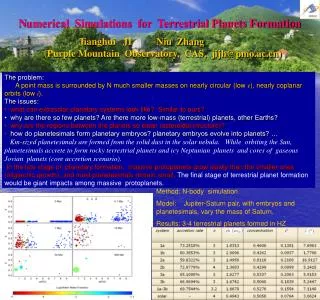
Numerical Simulations for Terrestrial Planets Formation Jianghui JI Niu Zhang (Purple Mountain Observatory, CAS, jijh@pmo.ac.cn) • The problem: • A point mass is surrounded by N much smaller masses on nearly circular (low e), nearly coplanar orbits (low i). • The issues: • what can extrasolar planetary systems look like? Similar to ours? • why are there so few planets? Are there more low-mass (terrestrial) planets, other Earths? • why are the regions between the planets so clean (asteroidal structure)? • how do planetesimals form planetary embryos? planetary embryos evolve into planets? … • Km-sized planetesimals are formed from the solid dust in the solar nebula. While orbiting the Sun, planetesimals accrete to form rocky terrestrial planets and icy Neptunian planets and cores of gaseous Jovian planets (core accretion scenario). • In the late stage of planetary formation, massive protoplanets grow slowly than the smaller ones (oligarchic growth), and most planetesimals remain small. The final stage of terrestrial planet formation would be giant impacts among massive protoplanets. Method: N-body simulation Model: Jupiter-Saturn pair, with embryos and planetesimals, vary the mass of Saturn. Results: 3-4 terrestrial planets formed in HZ