Exploring Knowledge Management: Insights from Day 2 of IeMBA KMNT 645
Day 2 of the IeMBA KMNT 645 course delved into the nuances of Knowledge Management (KM) and its historical and contemporary significance. Key topics included types of knowledge, the interaction between knowledge flows and business models, and the role of human agency in managing intangible assets. Expert insights from Larry Prusak and Jay Liebowitz provided a framework for understanding the economics of knowledge and the future of information management. Participants examined the interplay of rivalrous and non-rivalrous resources, emphasizing the importance of KM in synthesizing knowledge for better organizational outcomes.

Exploring Knowledge Management: Insights from Day 2 of IeMBA KMNT 645
E N D
Presentation Transcript
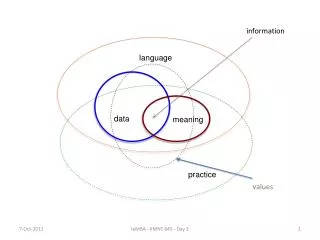
information language data meaning practice values IeMBA - KMNT 645 - Day 2
what did we do yesterday ? • types of knowing / knowledge • types of KM project • look at the world through the BM • elements, interaction and pulse of BM • KM focuses on surfacing and managing the knowledge aspects to be synthesized. It connects to the world via the BM • (DIKW) IeMBA - KMNT 645 - Day 2
KM - its past & present • Larry Prusak - IT, globalization, economics of knowledge • Jay Liebowitz - KM (IT) and the info-management future • Leif Edvinsson IC - accounting, the IC metrics future • knowledge flows - making system work better (K-plumbing) • firm, industry, region, nation, individual • Nonaka & Takeuchi 1995 - (a) tacit K, (b) K-generation 6th IFKAD 2011
interactions & methodology • instances - generalities • practice - reasoned • human agency, Murphy’s Law, work-arounds, … • options, choices, values - aesthetics, style • intangibles • ‘knowledge work’ IeMBA - KMNT 645 - Day 2
beyond ‘assets’ - to intangibles universe of things known to exist = resources valuation codification 2nd EDEN Seminar on Intangibles & IC
KM’s target - beyond scientific management • synthesis of causal and agentic ways of knowing • e.g. interplay of rivalrous and non-rivalrous resources (assets and potentials) • intangibles are of two very different types - unmeasured assets (ICa) and unrealized potentials (ICp) • how to control these differing resources ? • unmeasured assets - simply do better, improve accounting, e.g. churn rate • unrealized potentials - i.e. human agency • entrepreneurial imagination - vision • agentic activities of the people comprising network that creates value 2nd EDEN Seminar on Intangibles & IC
K-generation human work-effort 6th IFKAD 2011
double spiral of a non-zero cost - non-equilibrium world human agency - making a difference in the world 6th IFKAD 2011
Penrose’s business model • management team • services = f (resources, team’s K) • rate of growth • K carry-forward • extensibility of K • non-rivalrous (low cost) resource • KBV versus RBV IeMBA - KMNT 645 - Day 2
KM - again • management of priced and unpriced assets & capabilities (TCa, TCp, ICa, ICp) and their interaction/s • relationships - market and non-market • BM - the firm as a lens on the world • metrics ? • strategic layers, time horizons / pulses • diagnosis, discovery of action options and constraints • the centrality of the entrepreneurial / strategic imagination IeMBA - KMNT 645 - Day 2