Cyclotron Institute REU 2006
150 likes | 283 Vues
This work explores finite size effects on dilepton properties in relativistic heavy ion collisions, focusing on the Quark-Gluon Plasma (QGP) formed during such events. Utilizing data from the NA60 experiment, we analyze dilepton production mechanisms and investigate transverse momentum spectra through a two-component model. The study aims to enhance the understanding of Quantum Chromodynamics (QCD) interactions and the characteristics of matter under extreme conditions, contributing to insights on the early universe and the nature of QGP.


Cyclotron Institute REU 2006
E N D
Presentation Transcript
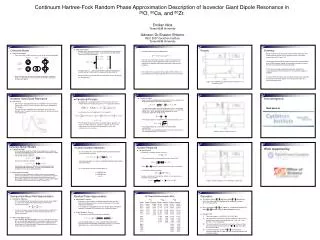
Cyclotron Institute REU 2006 Finite Size Effects on Dilepton Properties in Relativistic Heavy Ion Collisions Trent Strong, Texas A&M University Advisors: Dr. Ralf Rapp, Dr. Hendrik van Hees Texas A&M University Cyclotron Institute
QCD (Quantum ChromoDynamics) -QCD describes the interactions between quarks and gluons. -There are six flavors of quarks, and eight gluons, all carrying color charge -The force between quarks is strong and is linear in distance! (coupling constant αs≈1) -Force weakens at small distances (or high energies), so quarks essentially free within bounds (asymptotic freedom)
Relativistic Heavy-Ion Collisions At NA60: In-In @ 158 GeV/Nucleon -Colliders accelerate nuclei to very relativistic speeds! (RHIC, γ≈ 100, v=.9995c) -Nuclei collide, a hot and dense region is formed -In this region, the Quark-gluon plasma (QGP) and other forms of exotic matter like a hadron gas can form -They allow us to test further the theory of QCD and explore the early universe b
Quark-Gluon Plasma -Quark-Gluon Plasma (QGP)- form of matter predicted by QCD at high temperature and density. -Predicted transition temperature is ~ 170 MeV, corresponding to a temperature on the order of 1012 K. -As density and temperature become very large, hadrons formed by quarks overlap => quarks lose their affiliation with any particular hadron. -Quarks and gluons form a hot and dense soup!
Electromagnetic Probes: Dileptons and Photons Dileptons and photons good sources of information from a hot and dense medium since they: a.) are produced throughout the history of the collision. b.) do not interact strongly with the medium. The particles carry this information via their invariant massand 4-momentum. In a hadronic medium expected from such a collision, the ρ meson is the dominant producer of dileptons.
NA60:Dilepton Data Invariant Mass Spectra Plots: S. Damjanovic, QM05
NA60: Dilepton Data Transverse Momentum Spectra -Data show signs of a two-component spectrum, one component dominates at low pT while the other dominates at high pT
Two-Component Model Idea: Attempt to model spectra using two contributions… -Cocktail: Component from hard-scattering processes; surface contribution -Thermal or In-Medium: Components from thermal medium, such as QGP or hadron gas; bulk contribution Collision Zone Total Spectra = a ∙ (Thermal) + b∙ (Cocktail)
Results: Naive Two-Component Model in 4 Centrality Bins Peripheral Semiperipheral M[GeV] M[GeV] Semicentral Central
Naive Two-Component Model:Semicentral in two pT slices pT > 1.0 GeV pT < 0.5 GeV M[GeV] M[GeV]
Early Conclusions -Two Component Model seems to work well for inclusive pT bins, but shows deficiency in semicentral high-pT region. -Need to include smaller effects, other contributions to make model more complete
Dilepton Spectra: Theory ρ Spectral Function: -Spectral function gives distribution of rho mesons being produced per unit four position and unit four momentum -To obtain observed spectra, convolute over the entire spacetime history of the fireball expansion.