Connective Tissue
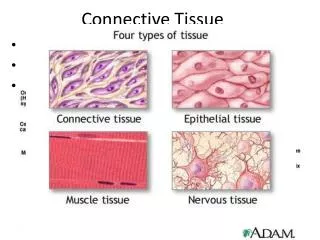
Connective Tissue. Thursday, September 5 th. What is connective tissue?. Forms a framework upon which epithelial tissue rests Also contains nerve and muscle tissue Is THE most abundant tissue type Classified more by the material in which the cells lay (extracellular matrix).


Connective Tissue
E N D
Presentation Transcript
Connective Tissue Thursday, September 5th
What is connective tissue? • Forms a framework upon which epithelial tissue rests • Also contains nerve and muscle tissue • Is THE most abundant tissue type • Classified more by the material in which the cells lay (extracellular matrix)
What is connective tissue? • Functions • Mechanical support for other tissues • Avenue for communication and transport among other tissues • The site of inflammation
What is connective tissue? • Extracellular matrix • Tissue made of different cells and different amounts of nonliving substances outside of cell • Variations in blood supply • Overall it has good blood supply, but there are a few exceptions • Avascular: ligaments, tendons, cartilage
What is connective tissue? • 3 Types of Fibers • White – strong and stretchy protein • Collagen • Yellow – more elastic but weaker protein • Elastin • Reticular – really thin fibers that provide support
How is connective tissue classified? • Classes • Bone • Cartilage • Dense connective tissue • Loose connective tissue (Areolar) • Adipose • Reticular • Blood
Bone Tissue • Exceptional ability to protect & support • Stores calcium and fat • Site for muscle attachment • Marrow is the site of blood production • 2 types • Cancellous – spongy bone • Compact – no space between
Bone Tissue Figure 4.12j
Cartilage • Small cells, sit in a lacuna • Hyaline cartilage • Less hard, more flexible • Most abundant • Ex: fetus skeleton • Fibrocartilage • Thick collagen fibers • Ex: disks in vertebral column • Elastic cartilage • Shape bounces back • Ex: external ear
Hyaline Cartilage Figure 4.12g
Fibrocartilage Figure 4.12i
Elastic Cartilage Figure 4.12h
Connective Tissues • 2 Types • Dense • Tendons – connect muscle to bone • Ligaments – connect one bone to another • Loose • Areolar – “cobwebs”, soft, pliable, protects the body organs as it wraps • Adipose – “fat”, insulation, abundant • Reticular – internal supporting framework (blood cells, spleen, bone marrow)
Dense Connective Tissue Figure 4.12f
Areolar Connective Tissue Figure 4.12b
Adipose Tissue Figure 4.12c
Reticular Connective Tissue Figure 4.12d
Blood Tissue • Atypical as far as connective tissue • No fibers, highly fluid • Transports O2 and CO2 • Vascular • It has blood cells surrounded by nonliving fluid called plasma
Blood Tissue Figure 4.12k
Blood Tissue • Plasma contents • Red blood cells: erythrocytes • White blood cells: leukocytes • Platelets: thrombocytes • Also carries nutrients (sugars, amino acids, fats, salts), antibodies, clotting proteins, hormones