Understanding Human Genetics: Chromosomes, Traits, and Disorders
Human genetics encompasses the study of our 46 chromosomes, including 23 pairs made up of autosomes and sex chromosomes which determine gender. This field faces challenges, such as long generations and ethical concerns. Methods for studying genetics include pedigrees, population sampling, and twin studies, leading to insights into dominant and recessive traits, codominance, and polygenic traits. Genetic disorders can arise from nondisjunction, leading to conditions like Down's syndrome. Advances in biotechnology, such as genetic engineering and gene therapy, hold promise for future discoveries.

Understanding Human Genetics: Chromosomes, Traits, and Disorders
E N D
Presentation Transcript
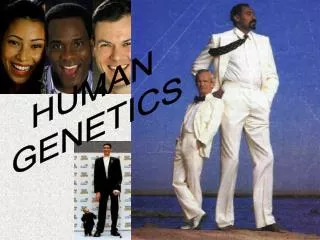
HUMAN GENETICS
Introduction • 46 chromosomes in each cell (23 pairs) • Autosomes: all chromosomes except sex chromosomes (22 pairs) • Sex chromosomes: determine gender (1 pair)
Sex determination • XX = female • XY = male • During meiosis, each egg from the female gets an X; 1/2 male sperm get X, 1/2 get Y • Males determine gender of offspring! • Except in birds and reptiles where female is XY and male is XX
Studying human genetics • Difficult because • Long generations (25 yrs) • Single births • Ethical concerns
Methods for studying humans • Pedigrees: record that shows how a trait is inherited within a family
Population sampling • Selecting a small # of people to represent an entire population • Must be a random sample • Ex: through random sampling, researchers discovered that 65% of people in US taste PTC, 35% cannot
Identical twin studies • Identical genetic codes • Separated at birth: study which traits are genetic(Nature) & which are environmental (Nurture)
Inheritance of human traits • Dominant traits • Polydactyly - extra fingers & toes • Dwarfism - small size • Curly hair • Huntington disease - nervous disorder • Piebaldness - white patches of hair
Piebaldness=Genetic Vitiligo=AutoImmune
Recessive traits • Straight hair • Freckles • Albino • Cystic fibrosis - lung disorder • Deafness • PKU - nervous disorder
Codominance • Sickle cell anemia - irregularly shaped red blood cells • O allele = healthy(HH) • 1 allele = mild case(HS), resistant to malaria • 2 alleles = severe case(SS)
Multiple alleles • 3 or more alleles which code for a single trait • Human blood type • 3 possible alleles: IA, IB, iO • IA & IB are codominant, iOis recessive • 41% of US is Type O -- o allele is most common
Polygenic traits • Controlled by 2 or more genes • Skin color - the more genes, the more melanin darker skin color • Height - more dominant alleles taller • Eye Color
Sex-linked traits • Genes located on X chromosome • Males only have one X, so only have one allele controlling these genes • Males more likely to have disorders that are sex-linked because they only need 1 recessive allele
Carrier: someone who has one allele for a disorder -- does not have the disease but can pass it on to children • Only women can be carriers for sex-linked traits • Examples: hemophilia, muscular dystrophy, colorblindness
Color vision • XC=Color Vision, Xc=colorblind • Males - 8% colorblind (XcY) • Females - 1% colorblind (XcXc) Red-Green Total Normal
What are the chances for a healthy dad and a mom who is a carrier for colorblindness to have a child that is colorblind?
Hemophilia in the Royal Families of Europe
Genetic disorders • Nondisjunction: failure of chromosomes to separate during meiosis • Normal = 23 chromosomes • Abnormal = 22 or 24
Monosomy: too few chromosomes, one chromosome left unpaired • Turner syndrome: female with only 1 X chromosome • Short stature, sterile
Trisomy: too many chromosomes, extra copy of one • Down’s syndrome: trisomy 21 • 1 in 1400 when mother under age 25, 1 in 100 by age 40
Detecting genetic disorders • Physical characteristics - features, disabilities • Ultrasound - pictures of baby in utero using sound waves • Amniocentesis - sample of fluid from around baby, can examine baby’s cells • http://www.biology.iupui.edu/biocourses/n100/2k4csomaldisordersnotes.html
Karyotype: picture of a person’s cromosomes • taken from any cells -- blood in adults, amnio for baby Trisomy 21 Normal
Biotechnology • Genetic engineering: manipulating the DNA of an organism • Select useful traits, such as resistance to diseases • Transgenic organisms: contain a gene from another organism
DNA fingerprinting • Analysis of DNA sequences to determine identity
C.Gene therapy • Once we know which genes code for specific proteins and cause disorders • Insert a normal gene into a chromosome to replace a dysfunctional gene • On hold until more research can be completed