Comprehensive Overview of Muscle Tissue Structures and Functions
Explore the microscopic structures, cellular components, and functions of skeletal, cardiac, and smooth muscle tissues. Learn about sarcomeres, intercalated disks, and the regeneration capabilities of different muscle fibers.

Comprehensive Overview of Muscle Tissue Structures and Functions
E N D
Presentation Transcript
MUSCLE TISSUE 1- Skeletal muscle. 2- Cardiac muscle. 3- smooth muscle.
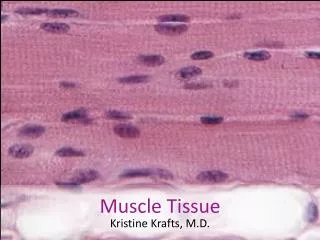
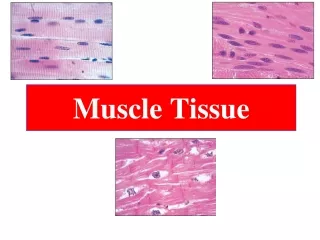
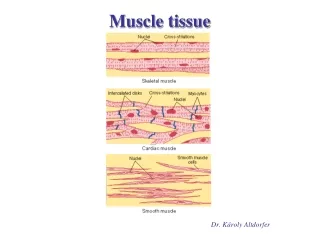
SKELETAL MUSCLE L/M of skeletal muscle fibers (cells): - Very long - Cylindrical - multinucleated - Nuclei are oval & peripheral - Show cross (transverse) striations - Sarcoplasm is acidophilic
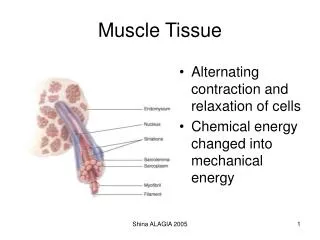
ORGANIZATION OF SKELETAL MUSCLE • C.T. Component: 1- Epimysium : dense C.T. surround the entire muscle 2- Perimysium:dense C.T. around each bundle (fascicle) of muscle fibers. 3- Endomysium: surrounds each muscle fiber. delicate C.T. composed mainly of reticular fibers & external lamina. Endomysium contains continuous blood capillaries and lymph vessels. * Muscle fibers are arranged in regular bundles.
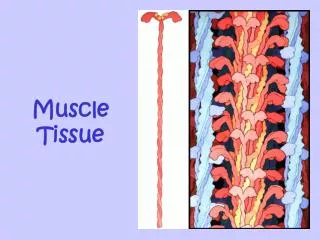
E/M of skeletal muscle fibers: • Sarcomere: Definition Structure N.B. M line consists of myomesin & C protein.
E/M of skeletal muscle fibers: • Sarcolemma, Transverse ( T ) tubules & Sarcoplasmic reticulum. T tubules: invaginations of the sarcolemma forming anastomosing network of tubules that encircles the boundaries of the A-I bands of each sarcomere in every myofibril.
E/M of skeletal muscle fibers: Sarcoplasmic reticulum ( S.R. ): 1- Terminal cisternae: 2 lateral portions of S.R. 2- Sarcotubules: branching network of S.R around each myofibril. • Triad: components = T.T.+ 2 T.C.
E/M of skeletal muscle fibers: * Mitochondria: numerous, elongated with many cristae. • Myoglobin: more in red fibers than in white fibers. • Glycogen granules.
TYPES OF SKELETALMUSCLE FIBERS 1- Red Muscle Fibers. 2- White Muscle Fibers. 3- Intermediate Muscle Fibers
CARDIAC MUSCLE L/M of cardiac muscle cells: - Have cross (transverse) striations. - Are usually mononucleated (may be binucleated). - Nuclei are oval & central. - are elongated , branched cells. - are parallel to each other. - Have intercalated disks ( at sites of end-to-end contact of cells in the same fiber). - Mitochondria: about 40%. - Lipofuscin pigments.
E/M of cardiac muscle cells: • Intercalated disks: Types: 1- Straight. 2- Steplike (stepwise) pattern. Junctions: 1- Fascia adherent. 2- Macula adherent (Desmosomes). 3- Gap junctions.
T Tubules: - are more numerous and larger (wider) in ventricular muscle. -are found at the level of Z lines. • Sarcoplasmic reticulum: - is not as well developed. • Diads. • Mitochondria: occupy 40 % of the sarcoplasmic volume. • Glycogen. • Lipofuscin pigment granules (aging pigment) • Secretory granules: more in Rt atrium, atrial natriuretic factor.
WALL OF THE HEART • (1) Endocardium. • (2) Myocardium. • (3) epicardium.
SMOOTH MUSCLE FIBERS( SMOOTH MUSCLE CELLS) L/M : - Do not show cross striations. - are fusiform. - have a single nucleus located in the center.
E/M of smooth M.F.: • No T tubules , No sarcomeres. • Abundant intermediate filaments: coursing through the sarcoplasm. *Dense bodies ( D.B. ): Types: 1- membrane-associated. 2- cytoplasmic. Both contain α-actinin ( are thus similar to Z lines ). Both actin & intermediate filaments insert to D.B. * Abundant gap junctions.
FUNCTIONS OF S.M.F.: 1- Contractile activity. 2- Synthesis of extracellular products e.g. collagen, elastin & proteoglycans.
REGENERATION OF MUSCLE (1) Skeletal muscle fibers ( cells): - can not divide. - limited regeneration by satellite cells ( inactive myoblasts ). (2) Cardiac muscle cells: Have almost no regenerative capacity beyond early childhood. (3) Smooth muscle fibers ( cells ): a- Can divide. b- Pericytes. --------→active regenerative response.