Overview of MECO Cryogenic System Design and Operation by Brad Smith
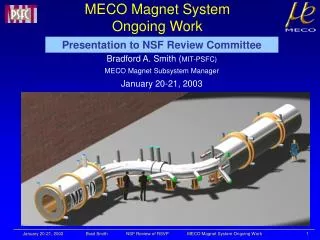
The MECO Cryogenic System, as presented by Brad Smith, encompasses a detailed overview of its components, including helium and liquid nitrogen systems, steady-state operations, and thermal designs of Dewars. The system features four separate cryostats and an efficient liquefier/refrigerator, designed for optimal cooling and flexibility during operations. Key focus areas include quench management, isolating cryostats during quench events, and conducting cooling with advanced techniques, ensuring reliable performance under varying heat loads.

Overview of MECO Cryogenic System Design and Operation by Brad Smith
E N D
Presentation Transcript
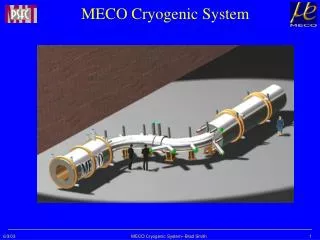
MECO Cryogenic System MECO Cryogenic System--Brad Smith
Overview • Helium System • Steady state 4.5 k system • Steady state heat loads and operating points • Thermal design of Dewars TS and DS • Thermal Design of PS Dewar • Liquid N2 System • Quench • Recool after Quench MECO Cryogenic System--Brad Smith
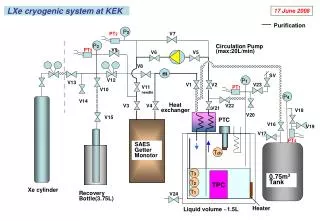
Component Overview • Four Separate Cryostats (PS, TS1, TS2 and DS) • One Liquefier/Refrigerator • Pressurized Liquid Nitrogen Tank-(Truck filled) • Forced Convection cooling in 3 dewars (TS1, TS2 and DS) • Conduction cooling from He tubes to the coils (No He bath) • PS is pool cooled- Natural convection and/or Forced flow cooling. • Two storage/control dewars • Vacuum insulated LN2 traced MLI. MECO Cryogenic System--Brad Smith
Design and Operation Overview • All active components are outside the shield wall. • Many interconnections and valves to allow for flexible operation. • Dewars can be cooled separately. • Cooling of one dewar does not affect the state of other dewars. • Valves allow the isolation of cryostats during a quench. • Cool down with He circulated from and LN2 heat exchanger for T>80 K. • Cool down with He from the liquefier for T<80K. • Dewars are protected against overpressure during a quench. MECO Cryogenic System--Brad Smith
Steady State Operation MECO Cryogenic System--Brad Smith
Estimated Heat Loads MECO Cryogenic System--Brad Smith
States in Cooling System MECO Cryogenic System--Brad Smith
Cryostat 4.5 K Cooling PS • Bath cooled with 6700 liter LHe volume to safely remove 192 W of nuclear heat load at 4.5 K • 25 cm diameter quench vent stack keeps quench pressure below 5 atmospheres TS and DS • Lack of nuclear heat load enables conduction cooling • Inner and outer copper shells intercept radiation heat load and take it to He-traced copper heat sinks at the top of each coil All cryostats have stainless steel vacuum shells and LN2-cooled thermal radiation shields. MECO Cryogenic System--Brad Smith
He Vessel Pressure for PS Quench MECO Cryogenic System--Brad Smith
Estimates of cooldown times Cooldown MECO Cryogenic System--Brad Smith
Liquid Nitrogen System • Tank filled by commercial vendor • LN2 distribution lines cool shields in 4.5 K conduits. • LN2 cools heat stations on valves and vacuum separators. • Commercial MLI systems combined with an LN2 shield is used for lines, cryostat and dewars. • LN2 cooled heat stations on mechanical supports in PS, DS and TS. • ~~More details on the Ozone issue in a later talk~~ MECO Cryogenic System--Brad Smith