Ocean Waves and Tides
Explore the fascinating world of ocean waves and tides. Waves, caused by wind, earthquakes, and gravitational forces of celestial bodies, showcase rhythmic movements carrying energy through water. Learn about crucial wave components such as crest, trough, wave height, and wavelength. Discover how waves behave as they reach the shore and the phenomenon of breakers. Delve into tides—the rise and fall of sea levels driven by the moon and sun's gravitational forces—uncovering the differences between high and low tides and the concept of tidal range.

Ocean Waves and Tides
E N D
Presentation Transcript
Waves • A Wave is a rhythmicmovement that carries energy through matter or space. • In oceans, waves move through seawater
Waves Caused by: • Wind • Earthquakes • Gravitational force of the Moon and Sun.
Parts of a Wave • Crest – highest point of a wave • Trough – lowest point of a wave • Wave Height – vertical distance between the crest and the trough • Wavelength – horizontal distance between two crests or two troughs
Wavelength Crest Wave Height Still Water Trough Wave Parts
Wave Movement • When a wave passes through the ocean, individual water molecules move up and down but they do not move forward or backward.
Wave Movement • When a wave breaks against the shore, the crest outruns the trough and the crest collapses. • Called a breaker. • In this case, water does move forward and backward.
Waves Caused by Wind • When wind blows across a body of water, friction causes the water to move along with the wind. • Wave Height depends on – • Wind speed • Distance over which the wind blows • Length of time the wind blows
Tides • The rise and fall in sea level is called a tide. • Caused by a giant wave. • One low-tide/high-tide cycle takes about 12 hrs and 25 min. • Tidal range is the difference in ocean level between high-tide and low-tide
What is the Tidal Range? • HT = 30 ft, LT = 20 ft • HT = 20 ft, LT = 12 ft • HT = 50 ft, LT = 20 ft
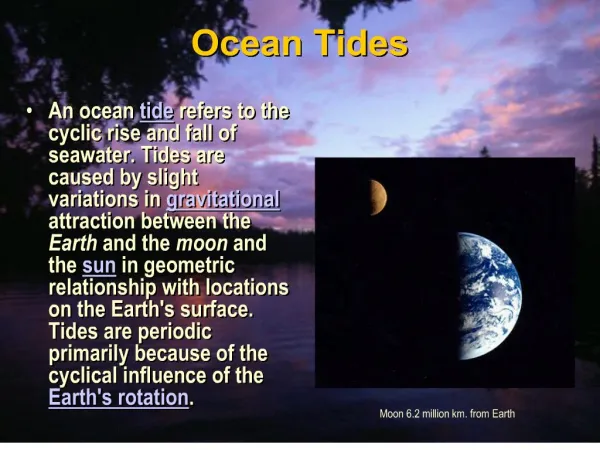
Gravitational Effect of the Moon • Two big bulges of water form on the Earth: • one directly under the moon • another on the exact opposite side • As the Earth spins, the bulges follow the moon.
Gravitational Effect of the Sun • Spring Tides • Earth, Moon, and Sun are lined up • High Tides are higher and Low Tides are lower than normal
Gravitational Effect of the Sun • Neap Tides • Earth, Moon, and Sun form right angles • High Tides are lower and Low Tides are higher than normal