Download
1 / 1
10 likes | 128 Vues
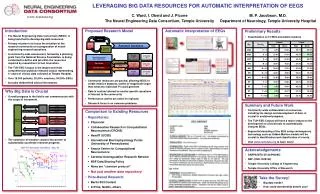
The Neural Engineering Data Consortium (NEDC) is pioneering the use of big data resources to enhance the automatic interpretation of EEGs. Spanning 11 years of clinical data from over 15,000 patients and 50,000 EEGs, the TUH EEG Corpus is a pivotal resource aimed at addressing key research questions in neural engineering. By pooling communal resources, the NEDC fosters a collaborative environment that accelerates innovation and drives the development of clinical tools. Discover how big data can transform EEG analysis and improve outcomes in neurology.

E N D
Leveraging Big Data Resources for Automatic Interpretation of EEGs C. Ward, I. Obeid and J. PiconeM. P. Jacobson, M.D. The Neural Engineering Data Consortium, Temple University Department of Neurology, Temple University Hospital PI PI PI Data Data Data Methods Methods Methods www.nedcdata.org Results Results Results Research Question Research Question Research Question Money Money Money Funded PI Unfunded PI Neural EngineeringDataConsortium • Automatic Interpretation of EEGs • Introduction • The Neural Engineering Data Consortium (NEDC) is being launched to develop big data resources. • Primary mission is to focus the attention of the research community on a progression of neural engineering research questions. • A community-wide assessment, funded by a planning grant from the National Science Foundation, is being conducted to define and prioritize the resources required by researchers to fuel innovation. • The TUH EEG Corpus is the largest and most comprehensive publicly-released corpus representing 11 years of clinical data collected at Temple Hospital. • Over 15,000 patients, 20,000+ sessions, 50,000+ EEGs • Includes deidentified clinical information. • Proposed Research Model • Communal resources are pooled, allowing NEDC to create massive datasets, orders of magnitude larger than what any individual PI could generate • Data is custom tailored to resolve specific questions of interest to the community • Performance claims are easier to replicate • Research focus is on common problems • Preliminary Results • Classification of 12 EEG annotation markers Unfunded PI Data Design Funded PI Data Generation Unfunded PI Funded PI • Why Big Data is Crucial • Overall progress in the field is not commensurate with the scope of investment. • The existence of massive corpora has proven to substantially accelerate research progress. • Summary and Future Work • Community-wide collaboration on resources, including the design and development of data, is crucial to sustained progress. • The TUH-EEG Corpus will have a major impact on the development of clinical tools to automatically interpret EEGs. • Sequential decoding of the EEG using contemporary technology such as hidden Markov models will be crucial to identification and classification of events. • Visit www.nedcdata.org to learn more! Funding Agencies • Comparison to Existing Resources • Repositories: • Physionet • Collaborative Research in Computational Neuroscience (CRCNS) • HeadIT (UCSD) • International Electrophysiology Portal (University of Pennsylvania) • Swartz Center for Computational Neuroscience • Cerebral Autoregulation Research Network • NSF Data Sharing Policy • None are “common protocol” • Not just another data repository! • Prize-Based Research: • Berlin BCI Contest • X-Prize, Netflix, others • Acknowledgements • DARPA/MTO (D13AP00065) • NSF (CNS-1305190) • Temple University College of Engineering • Temple University Office of Research Industry PI Research Questions Funding Agencies Fees Data Results Results Scoring • Take the Survey! • Big data needs? • How could membership benefit you?