Understanding Alternate Exterior Angles and Triangle Congruence
This lesson explores the concept of alternate exterior angles, the sum of exterior angles in polygons, and the relationship between interior and exterior angles at polygon vertices. We review congruent triangles, including proofs and the Third Angle Theorem. Students will engage in tracing and labeling shapes, identifying congruent sides and angles, and completing textbook exercises for reinforcement. This summary also highlights key relationships among quadrilaterals, triangles, and parallel lines.

Understanding Alternate Exterior Angles and Triangle Congruence
E N D
Presentation Transcript
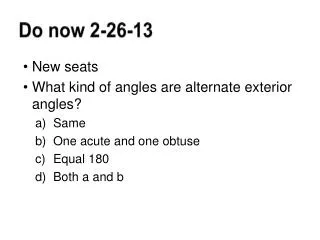
Do now 2-26-13 • New seats • What kind of angles are alternate exterior angles? • Same • One acute and one obtuse • Equal 180 • Both a and b
Review from Monday • What is the sum of the exterior angles of polygons? • 360 • What conclusion can be made about the interior and exterior angles of a polygon at each of its vertices? • Supplementary
Review from Monday How do quadrilaterals, congruent triangles, and parallel lines coincide? Or have a relationship together? Triangles and lines have 180 degrees in common Try, pg. 181 #15, #16, and #18 Pg. 209 #25, #26
congruence Chapter 4.1 pearson Parallel lines and congruent figures http://youtu.be/VY-8jMnFkuM http://youtu.be/69lfTURDles
polygons http://youtu.be/hBdiR8dwY_8 Each student gets 2 shapes or their own bag of shapes pg. 218- 224 Trace each shape Label each angle/vertex Identify congruent corresponding sides and angles (parts) Definition: Third angle thm: if two congruent, then third is congruent
Proofs (you do, then we check) Given triangle QXR is congruent to triangle NYC Then line segment QX is congruent to line segment ______
Lesson check pg. 221 1 – 7
Textbook work to make sure you have done Pg. 176 #26 Pg. 356 #7, 15, Pg. 357 #28, 30 Pg. 358 #47
Summary 2-26-13 How do you show that two triangles are congruent? Provide one way with description