Download
1 / 17
180 likes | 316 Vues
This presentation by Dr. Paul D. West from the U.S. Military Academy explores the evolution of military wargaming from its rudimentary beginnings to its current state and future directions. It covers historical combat simulations, the integration of operational and mathematical sciences, and the development of analytical tools for training and recruitment. The presentation also emphasizes the role of modern technology, including AI and high-fidelity simulations, in creating effective combat scenarios for education and analysis. Discover how the military prepares for future challenges through advanced wargaming techniques.

E N D
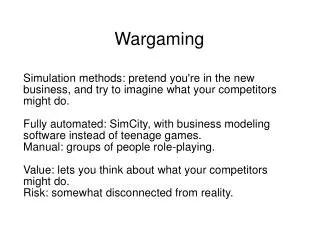
Current Military Wargaming Use A View from the United States Military Academy Dr. Paul D. WestDepartment of Systems Engineering
Agenda • Where we’ve been • Where we are • Where we’re going • Contact info
Where We’ve Been • Combat wargaming has been around since just after Cain slew Abel (I think) • Mathematical analysis of combat grew considerably from the early 1900s (Lanchester) • The marriage of operational and mathematical science flourished in World War II • Operational and RDT&E analysis have been increasingly interwoven since then
Where We Are • Analysis of tactics, techniques, procedures • Education and Training • Analysis of material solutions (RDT&E) • Recruiting • Analysis of M&S capabilities in rapidly changing, high-technology world • LZ X-Ray, Troy, D-Day
America’s Army Concept developed by West Point’s Office of Economic and Manpower Analysis as a recruiting analysis tool Now more than 9 million registered players
Historical Simulation • Identifies capability gaps in wargames and simulations • Allows for multiple what-if scenarios • Provides a reasonable testbed for evolving TTPs and capabilities • Examples: • LZ X-Ray, Ia Drang Valley, Vietnam • Troy • Pegasus Bridge, Normandy, D-Day
Purpose of the Work Phase 1: Explore the feasibility of replicating a Vietnam-erabattle in simulation, using 1960s and Land Warriortechnologies Phase 2: Given feasibility, recreate a Vietnam-era infantry battle to provide vignettes for comparingLand Warrior and non-Land Warrior equipped forces
Why • recreate history in simulation? • Troy? • Where • Was Troy and what did it look like? • Who • were the combatants and how many were there? • What • factors need to be modeled? • How • can modern combat simulations model the Trojan War?
Where We’re Going • Increased reliance on high-quality AI • Autonomous behaviors • Interactivity; High-Fidelity First-Person Shooter • Highly customizable scenarios • TTPs in theater have ~ a two-week lifespan • Scenarios must keep pace with technology infusions • Rapid system modeling • Analyst level, GUI driven
Contact Info Dr. Paul D. West Department of Systems Engineering United States Military Academy West Point, New York 10996 Paul.West@usma.edu Paul.D.West@us.army.smil.mil (845) 938-5871 (845) 729-3634 Mobile