Download
1 / 6
60 likes | 174 Vues
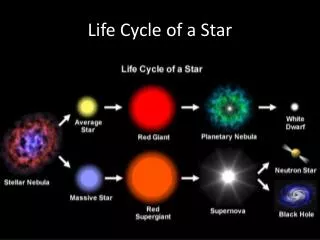
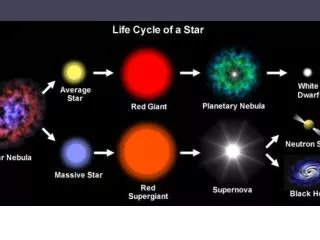
Explore the fascinating journey of a star's life cycle, beginning with a nebula, a large cloud of gas and dust. Gravity compresses these materials, forming a protostar. Depending on its mass, a protostar evolves into either a low, medium, or high-mass star, leading to its ignition. As stars age, they transform into giants or supergiants, eventually expiring in dramatic events. Low and medium-mass stars become white dwarfs or planetary nebulae, while massive stars end in supernovae, leaving behind neutron stars or even black holes. This cycle enriches the universe with elements.

E N D
A Star is Born • From Nebula to Protostar… • Nebula • Large cloud of gas and dust • In the densest part of nebula, gravity pulls gas and dust together • As it contracts, it heats up • When large enough, a Protostaris formed
A Star is Born • From Nebula to Protostar… • Protostar • First stage in a star’s life • Low and Medium mass protostarscreate low-mass or medium-mass stars • High-mass protostarscreate high-mass stars
Everything has an end … • From Star to giant • giants • Star begins to run out of hydrogen • Core shrinks, outer portion expands • Low and Medium mass stars turn into Red giants • High-mass stars turn into Supergiants
Everything has an end … • Red Giant death • Planetary nebula • Glowing cloud of gas • Very brilliant • White Dwarf • Extremely dense (1,000,000 times as dense as the sun)
Everything has an end … • Supergiant death • Supernova • Sudden explosion of Supergiant • Explosion sends elements into space to potentially become other nebula • Neutron Star • Smaller and more massive than White Dwarf • Spinning Neutron stars are called Pulsars • Black Holes • Gravity so strong, nothing escapes • Created only by the largest stars