The Life Cycle of Stars: From Nebula to Black Holes
420 likes | 556 Vues
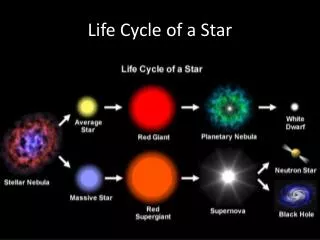
Explore the fascinating journey of stars through the cosmos, beginning in stellar nurseries known as nebulae, where hydrogen fuels their birth. As stars evolve, they can become red giants, burning helium, or white dwarfs that eventually cool to become black dwarfs. The dramatic end of massive stars leads to spectacular supernovae, leaving behind neutron stars or black holes, points of gravity so strong that not even light can escape. This journey reveals the intricate processes that govern the life cycles of stars in our universe.


The Life Cycle of Stars: From Nebula to Black Holes
E N D
Presentation Transcript
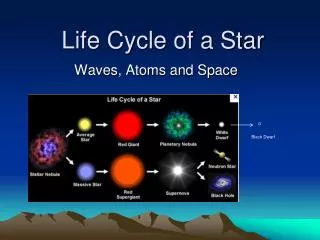
Nebula A cloud of dust and gas in which new stars form
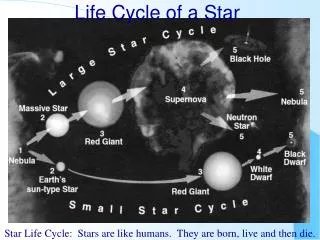
Nebula Star -uses Hydrogen as fuel
Nebula Star -uses Hydrogen as fuel Red Giant -uses Helium as fuel
Red giant Stars that begin to expand as they use up their fuel
Nebula Star -uses Hydrogen as fuel Red Giant -uses Helium as fuel White Dwarf -no fuel
White Dwarf When helium is used up, the outside layers of gas float off and only the core will remain
Nebula Star -uses Hydrogen as fuel Red Giant -uses Helium as fuel White Dwarf -no fuel Black Dwarf -thermal energy cools
Black Dwarf When a white dwarf completely cools down. This is completely hypothetical.
Nebula Star -uses Hydrogen as fuel Red Giant -uses Helium as fuel White Dwarf -no fuel (binary star system) Supernova Black Dwarf -thermal energy cools
Nebula Star -uses Hydrogen as fuel Red Giant -uses Helium as fuel (massive star) Supernova White Dwarf -no fuel (binary star system) Supernova Black Dwarf -thermal energy cools
Supernova When a massive star cools, its core will shrink until it can’t shrink anymore. The sudden stopping sends out shock waves and a huge explosion
Cassiopeia A Supernova, youngest supernova in Milky Way Galaxy 1667
Nebula Star -uses Hydrogen as fuel Red Giant -uses Helium as fuel (massive star) Supernova White Dwarf -no fuel (binary star system) Neutron Star -spins -gives out radio waves “pulsar” Supernova Black Dwarf -thermal energy cools
Neutron Star A leftover ball of neutrons after a supernova
Crab Nebula is the remnants of a supernova explosion. In the center is a neutron star
Nebula Star -uses Hydrogen as fuel Red Giant -uses Helium as fuel (massive star) Supernova White Dwarf -no fuel (binary star system) Neutron Star -spins -gives out radio waves “pulsar” Black Hole Supernova Black Dwarf -thermal energy cools
Black Hole After a supernova, the remaining core of the star can shrink into a black hole. This is a point in space with such a strong force of gravity that nothing within a certain distance of it can escape getting pulled in, not even light.
http://hubblesite.org/explore_astronomy/black_holes/index.htmlhttp://hubblesite.org/explore_astronomy/black_holes/index.html