Observing and Collecting Data
Chapter 2 focuses on essential aspects of observing and collecting data in scientific research. It differentiates between qualitative and quantitative data and explains how systems are defined in studies. The chapter introduces the concept of hypotheses formed from generalizations of data, typically in "if-then" format. It covers experimental design, highlighting the roles of independent and dependent variables, setting controls, and the importance of SI units for measurement. It also discusses accuracy versus precision in measurements, crucial for scientific validity and reliability.

Observing and Collecting Data
E N D
Presentation Transcript
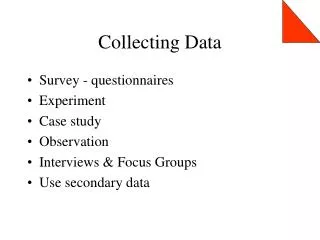
Chapter 2 Observing and Collecting Data • Observing is the use of the senses to obtain information. • data may be • qualitative (descriptive) • quantitative (numerical) • A system is a specific portion of matter in a given region of space that has been selected for study during an experiment or observation.
Hypothesis • Scientistsmake generalizations based on the data. • Scientists use generalizations about the data to formulate a hypothesis, or testable statement. • Hypotheses are often “if-then” statements
Experimental Design • Testing a hypothesis requires experimentation that provides data to support or refute a hypothesis or theory. • Controls are the experimental conditions that remain constant. • Variables areany experimental conditions that change.
Experimental Design • Independent variable – is the manipulated variable or the variable that the experimenter changes. • The dependent variable – is the variable that changes due to the independent variable. • Graphing – we put the independent variable on the X-axis and the dependent variable on the y-axis
SI Units • SI units of measure are the accepted units of measure for science. • The SI unit is based on multiples of 10.
Mass is a measure of the quantity of matter. The SI standard unit for mass is the kilogram. Weight is a measure of the gravitational pull on matter. Mass does not depend on gravity
Length is a measure of distance. The SI standard for length is the meter. The kilometer, km, is used to express longer distances The centimeter, cm, is used to express shorter distances
Combinations of SI base units form derived units. pressure is measured in kg/m•s2, or pascals
Density is the ratio of mass to volume, or mass divided by volume. • The derived SI unit is kilograms per cubic meter, kg/m3 • g/cm3 or g/mL are also used
Accuracy and Precision • Accuracy refers to the closeness of measurements to the correct or accepted value of the quantity measured. • Precision refers to the closeness of a set of measurements of the same quantity made in the same way.