Atomic Theory
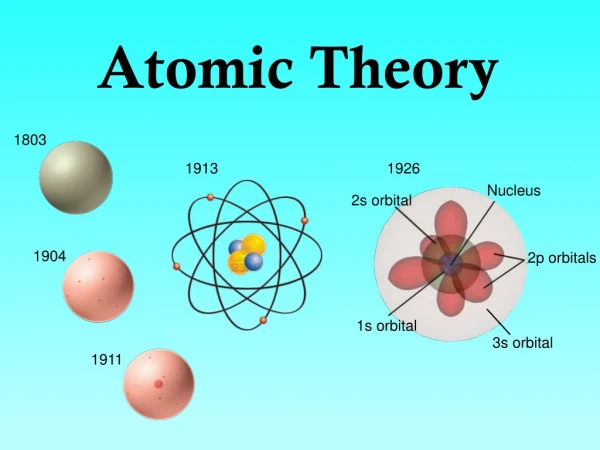
Explore the journey of atomic theory from ancient insights by Democritus to modern quantum mechanics. Discover how John Dalton established foundational postulates about atoms, leading to J.J. Thomson's electron discoveries through cathode rays. Delve into Ernest Rutherford's groundbreaking gold foil experiment that unveiled the atomic nucleus, and learn about Max Planck's introduction of quantized energy levels. Finally, investigate Niels Bohr's energy level theory and the implications of quantum mechanics, including the Heisenberg Uncertainty Principle.

Atomic Theory
E N D
Presentation Transcript
Atomic Theory Ancient and Modern
Ancient Theory Democritus • Greek philosopher/scientist • Stated that everything is made up of “void” in which exists infinite, tiny, indivisible particles • “Atom” comes from Gr. “atomon,” meaning “indivisible”
John Dalton (1766-1844) 5 basic postulates: • All matter consists of tiny particles called atoms • Atoms are indestructible and unchangeable • All atoms of the same element have the same weight, and all atoms of different elements have different weights* • Atoms in reactions combine in simple, whole-number ratios (Law of Definite Proportions) • Sometimes atoms combine in more than one simple, whole-number ratio *We now say that atoms of the same element have the same “nuclear charge”
J.J. Thomson (1856-1940) • “Cathode ray” (stream of electrons) experiment • “Plum-pudding” model of the atom • Mass-to-charge ratio of electron J.J. Thomson’s cathode ray apparatus—the negatively-charged “cathode rays” (electrons) are attracted to the positively-charged plate
Ernest Rutherford (1871-1937) • Discovered nucleus with gold foil experiment • Shot He atoms at a piece of gold foil surrounded by radioactive Zn—if plum-pudding model was correct, atoms should go straight through • Found that some atoms ricocheted! • Concluded that atoms have a dense, positive core (nucleus)
Max Planck (1858-1947) • Looked at light emitted by heated materials • Came up with an equation that related energy emitted to the frequency of light emitted E=h f h=constant (6.626 x 10⁻³⁴ J s) f=frequency (Hz) E=energy (J) • Discovered that energy can only be emitted in discrete packets, called “quanta” (sing. “quantum”)
Whee!! 4 3 2 1 Niels Bohr (1885-1962) • Postulated that atoms have different energy levels • Theorized that electrons can absorb photons of light and “jump” from one energy level to the next • When electrons fall back, they emit photons of light Energy level H atom
Quantum Theories • Each electron in an atom has 4 quantum numbers to define position and properties: • Principal quantum number (n)—describes e- energy level: n=1,2,3… • Angular momentum quantum number(l)—describes orbital:l=0for s, 1 for p, 2 for d, etc. • Magnetic quantum number (ml)—describes position (i.e. which “box” in orbital diagrams):ml= -lto +l • Spin quantum number (ms)—describes movement: -½, +½ • Pauli Exclusion Principle: no two electrons can have the same 4 quantum numbers
More Quantum Stuff Chromium orbital-filling diagram ml=-1 ml=0 ml=1 ml=0 S orbital: n=1, l=0 S orbital: n=2, l=0 P orbital: n=2, l=1 S orbital: n=2, l=0 P orbital: n=3, l=1 D orbital: n=3, l=2 n=3, l=2, ml=-2, ms=+½
Yet More Quantum Stuff • Albert Einstein (1879-1955): Light has properties of both particles and waves. • Louis de Broglie (1892-1987): Matter has wave-like properties. • Heisenberg Uncertainty Principle: It is impossible to know both speed and position of an electron at the same time.
Bibliography www.britannica.com/ nobel/cap/oruthef002a4.html http://www.bookrags.com/sciences/chemistry/atomic-theory-woc.html