Understanding Irony: Types, Examples, and Audience Perception
This PowerPoint presentation explores the concept of irony, inviting learners to fill in the blanks as we go through the material. Irony is a literary device that expresses the opposite of the literal meaning and highlights the contrast between expected and actual outcomes. We discuss three main types: verbal irony (sarcasm), situational irony (unexpected events), and dramatic irony (tension between audience knowledge and character ignorance). Engaging examples illustrate each type, helping students grasp this complex concept in literature and drama.

Understanding Irony: Types, Examples, and Audience Perception
E N D
Presentation Transcript
IRONY Please fill in the blanks on your notes as we go through this PowerPoint.
What is Irony? (Fill in the blanks on your notes!) To use words to express the opposite of the literal meaning. To show the absurdity between actual result of events and the normal or expected result. Frequently, the audience (reader) of a drama or piece of literature will understand the irony whereas the characters in the story may not.
There are many types of Irony • Verbal (Sarcasm) • Situational (Event) • Dramatic (Suspense)
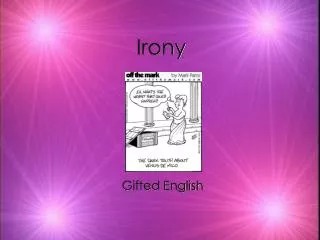
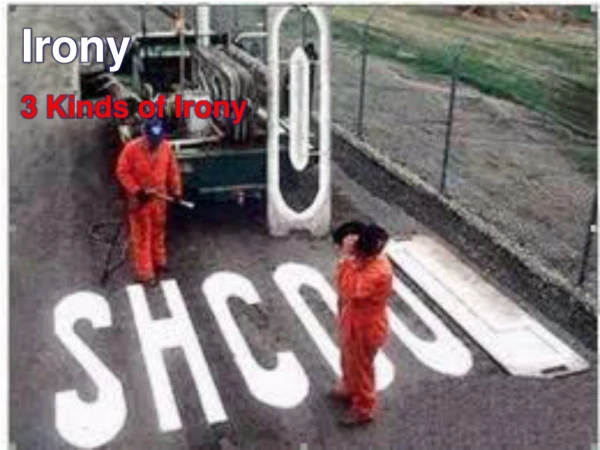
Situational Irony (Event) • When the opposite of what you expected happens • Example: You wash your car and then it rains • What is ironic about this cartoon?
Verbal Irony (Sarcasm) (Fill in the blanks on your notes!) • Sarcasm is verbal irony; it is praise which is really an insult; sarcasm generally involves malice (meanness), the desire to put someone down • Example: "This is my brilliant son, who failed out of college.“ • How is this ironing (irony) board being sarcastic?
Dramatic Irony (Suspense) • When the reader or audience are aware of something that the characters in the story are not. • Make the readers/ audience feel suspense! • Example: The robber is in the house and the family just got home from vacation and is walking into the front door.