Introduction to Microfluidic Networking: Principles, Applications, and Challenges
550 likes | 683 Vues
This document serves as an introductory overview of microfluidics, exploring its fundamental principles, system challenges, and the burgeoning interest in the field. Microfluidics, the science and technology of manipulating small fluid volumes in microchannels, offers numerous advantages including optimal flow control, reduced reagent use, and enhanced analysis efficiency. This work outlines key aspects of droplet-based microfluidics, networking modules, and innovative applications, while discussing ongoing research challenges essential for future advancements in the field.


Introduction to Microfluidic Networking: Principles, Applications, and Challenges
E N D
Presentation Transcript
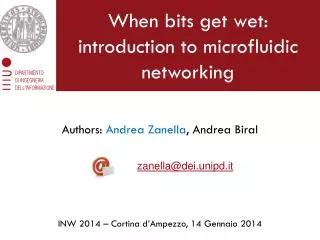
When bits get wet: introduction to microfluidic networking Authors: Andrea Zanella, Andrea Biral zanella@dei.unipd.it INW 2014 – Cortina d’Ampezzo, 14 Gennaio 2014
Purposes • Quick introduction to the microfluidics area • Overview of the research challenges we are working on… • Growing the interest on the subject… to increase my citation index!
Microfluidics Microfluidics is both a science and a technology that deals with the control of small amounts of fluids flowing through microchannels
Features MACROSCALE: inertial forces >> viscous forces turbolent flow microscale:inertial forces ≈ viscous forces laminar flow
Advantages • Optimum flow control • Accurate control of concentrations and molecular interactions • Very small quantities of reagents • Reduced times for analysis and synthesis • Reduced chemical waste • Portability
Market • Inkjet printheads • Biological analysis • Chemical reactions • Pharmaceutical analysis • Medical treatments • …
Droplet-basedmicrofluidics • Smalldrops (dispersedphase) are immersed in a carrierfluid (continuousphase) • very low Reynolds number (Re«1) • Viscous dominates inertial forces • linear and predictable flow • generation of mono-dispersed droplets • low Capillary number (Ca«) • surface tension prevail over viscosity • cohesion of droplets
Pure hydrodynamicswitchingprinciple • Droplets flow along the path with minimum hydraulic resistance • Channel resistance is increased by droplets Seconddrop “turnsleft” Twoclosedropletsarrive at the junction First drop “turns right”
Microfluidicbubblelogic • Droplet microfluidics systems can perform basic Boolean logic functions, such as AND, OR, NOT gates
Next frontier • Developing basic networking modules for the interconnection of different LoCs using purely passive hydrodynamic manipulation • versatility: same device for different purposes • control: droplets can undergo several successive transformations • energy saving • lower costs
Challenges • Droplets behavior is affected by various intertwined factors • flows in each channel depend on the properties of the entire system • Topology & geometrical parameters • Fluids characteristics (density, viscosity, …) • Obstacles, imperfections, … • Time evolution of a droplet-based microfluidic network is also difficult to predict • the speed of the droplets depends on the flow rates, which depend on the hydraulic resistance of the channels, which depend on the position of the droplets…
Our contributions • Derive simple ``macroscopic models’’ for the behavior of microfluidic systems as a function of the system parameters • Define a simple Microfluidic Network Simulatorframework • Apply the method to study the performance of a microfluidic network with bus topology
Basic building blocks • Droplet source • Droplet switch • Droplet use (microfluidic machines structure)
Droplets generation (1) • Breakup in “cross-flowingstreams” under squeezing regime
Droplets generation (2) • By changing input parameters, you can control dropletslength and spacing, but NOT independently! (volumetric flow rate Qd) (volumetric flow rate Qc) Constant (~1)
Junction breakup • Whencrossing a junction a droplet can break up… • To avoid breakup, dropletsshallnot be too long…[1] [1] A. M. Leshansky, L. M. Pismen, “Breakup of drops in a microfluidic T-junction”, Phys. Fluids, 21.
Junction breakup To increasedropletlengthyou must reduce capillarynumberCa reduce flow rate dropletsmovemore slowly! Non breakup
Microfluidic/electricalanalogy (I) Volumetric flow rate Electrical current Pressure difference Voltage drop Hydraulic resistance Electrical resistance Hagen-Poiseuille’slaw Ohm laws Pneumatic source →voltagegenerator Syringepump →currentgenerator
Microfluidic/electricalanalogy (II) Microfluidicchannelfilledonlybycontinuousphase ↓ resistorwith Bypass channel (ductsthatdropletscannotaccess) ↓ resistorwithnegligeableresistance Microfluidicchannelcontaining a droplet ↓ seriesresistorwith
Example Droplet 2 Droplet 2 Droplet 2 Droplet 2 Droplet 1 Droplet 1 Droplet 1 R1<R2 First droplet takes branch 1 R1+d>R2 Second droplet takes branch 2 Droplet 1 Droplet 2 Droplet 2 Droplet 1 Droplet 1
Microfluidic Network Model • G(t)=(V,E) • V={v1,…,vNnodes} E={e1,…,eNedges}
Parallelwithelectrical network • Static MN graph is mapped into the dual electric circuit • flow generator • pressure generator • microfluidic channel • bypass channel
Resistance evaluation • Eachdropletisassociated to its (additional) resistancewhichisadded to that of the channel
Case study: microfluidic network with bus topology Payload Header
Topologicalconstraints (I) • Header must always flow along the main path: expansion factor with a >1 • Outlet branches closer to the source are longer
Topologicalconstraints (II) • Payload shall be deflected only into the correct target branch • Different targets require headers of different length HEADER RESISTANCE Headers MM #N MM #2 MM #1
Performance • Throughput • volume of fluid conveyed to a generic MM per time unit (S [μm3/ms]) • Access strategy • “exclusive channel access”: one header-payload at a time!
Conclusions and future developments • AddressedIssues: • Definition of a totally passive droplet’s switching model • Design of a macroscopic droplet-based Microfluidic Network Simulator • Analysis of case-study: microfluidic bus network • A look intothe future • Joint design of network topology and MAC/schedulingprotocols • Design and analysis of data-buffer devices • Propermodeling of microfluidicsmachines • Characterization of microfluidicstrafficsources • Information-theoryapproach to microfluidicscommunications • …
When bits get wet: introduction to microfluidic networking Any questions? If we are short of time at this point… as it usually is, just drop me an email… or take a look at my papers!
Microfluidicbubblelogic • Recent discoveries prove that droplet microfluidic systems can perform basic Boolean logic functions, such as AND, OR, NOT gates.
Key elements • Source of data • Switching elements • Network topology
Droplets generation (1) • Breakup in “cross-flowingstreams” under squeezing regime
Droplets generation (2) • By changing input parameters, you can control dropletslength and spacing, but NOT independently!
Junction breakup • Whencrossing a junction a droplet can break up…