310 likes | 449 Vues
In this week's math activities, we will explore the concepts of surface area and volume in prisms and cylinders. Start your day with a warm-up, followed by engaging tasks on calculating areas of different shapes. Special activities are scheduled for Pi Day and a comprehensive review of prisms and cylinders. We'll also tackle finding surface areas using formulas and nets, and understand volume calculations. Don't forget to keep your binder organized and submit your Composite Figures worksheet by 2:10 PM!
E N D
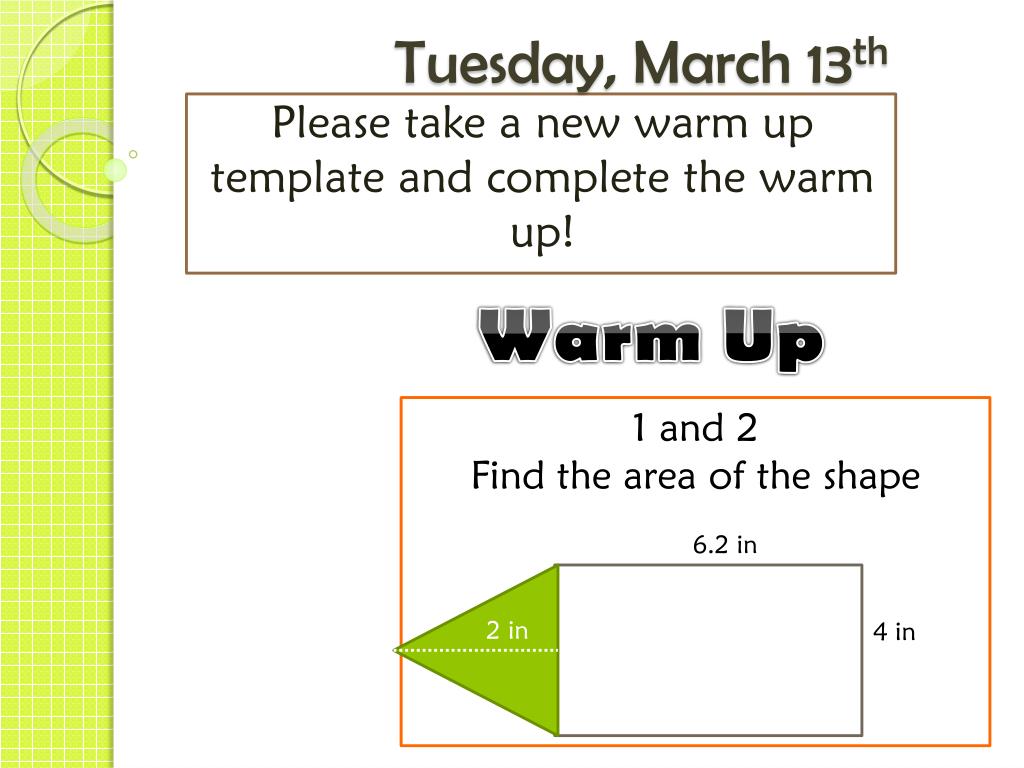
Tuesday, March 13th Please take a new warm up template and complete the warm up! Warm Up 1 and 2 Find the area of the shape 6.2 in 4 in 2 in 4 in
Joke of the DayBasketball Week Why are basketball players messy eaters? They are always dribbling
Week at a Glance Today: SA and V of Prisms Wednesday: Pi Day! Prism Activity Thursday: SA and V Cylinders Friday: *Progress Reports Cylinder and Prism Activity Monday: Checkpoint Prisms & Cylinders
Binder Clean out Keep everything in the FRONT of your binder (goal sheet, warm ups, syllabus, CRCTS< etc.) Put everything GRADED in your PORTFOLIO Throw everything else away
Composite Figures Worksheet Due at 2:10
The surface area of a three-dimensional figure is the sum of the areas of its surfaces. Units squared! To help you see all the surfaces of a three-dimensional figure, you can use a net. A net is the pattern made when the surface of a three-dimensional figure is layed out flat showing each face of the figure. COVER
Rectangular Prisms Rectangular Prisms- have a total of 6 faces. We need to find the area for all 6 faces, and then add them together (remember- some faces will be congruent)
Part 1: Surface Area Using a Net Using a Formula
#1 Try Together! Find the surface area S of the prism. Use a net! Draw a net to help you see each face of the prism. Use the formula A = lw to find the area of each face.
Add the areas of each face. Finding the Areas of each! A: A = 5 2 = 10 B: A = 12 5 = 60 C: A = 12 2 = 24 D: A = 12 5 = 60 E: A = 12 2 = 24 F: A = 5 2 = 10 S = 10 + 60 + 24 + 60 + 24 + 10 = 188 The surface area is 188 in2.
#2 You Try Let’s Label the Rectangles!
You Try #3 Rectangle
Remember! Area of a TRIANGLE is ½ x b x h
You Try #2 Triangular Prism 12 in It has FIVE faces! 5 in 4 in
#1 Try Together! SA= 2(lw)+2(wh)+2(lh) SA=_____________+_____________+___________ SA=_____________+_____________+___________ SA=_________
#2 You Try! SA= 2(lw)+2(wh)+2(lh) SA=_____________+_____________+___________ SA=_____________+_____________+___________ SA=_________
Since a cube has 6 faces we can really find the area of just ONE face and then MULTIPLY it by 6!
Cube: Try together! 7 in
1 face= 7 x 7=49 49 x 6 =
It takes 10, or 5 · 2, centimeter cubes to cover the bottom layer of this rectangular prism. There are 3 layers of 10 cubes each to fill the prism. It takes 30, or 5 · 2 · 3, cubes. Volume is expressed in cubic units, so the volume of the prism is 5 cm · 2 cm · 3 cm = 30 cm3.
To find the volume of any prism, you can use the formula V= Bh. Where B is the area of the base, and h is the prism’s height. • The base of a RECTANGULAR prism is a rectangle so the base is: l x w • To find the volume of a triangular prism, B is the area of the triangular base so the base is: ½ x b x h
FORMULA SHEET a=Bh l x w Rectangular Prism: Cylinder Prism:
#1 Try Together v=Bh B= l x w 13 in. 11 in. 26 in. V = lwh Write the formula. V = 26•11•13 l = 26; w = 11; h = 13 V = 3,718 in3 Multiply.
#2 Try Together v=Bh B= l x w 16 in. 12 in. 29 in. V = lwh Write the formula. V = 29•12•16 l = 29; w = 12; h = 16 V = 5,568 in3 Multiply.
#3 You Try! a=Bh B= l x w A rectangular prism with base length 6 ft, width 5 ft, and height 7 ft
1 1 __ __ 2 2 V = Bh Write the formula. V = ( •3.9•1.3) •4 B = •3.9•1.3; h = 4. #3 Try Together! a=Bh B= ½ x b x h V = 10.14 m3 Multiply.