CONNECTIVE TISSUE PROPER
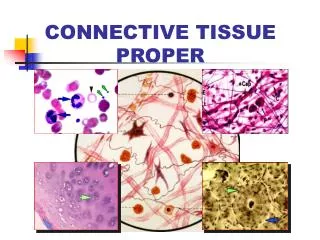
Learn about the characteristics and classification of connective tissue proper, including loose connective tissue. Explore the different cell types, fibers, and ground substance present in this tissue.

CONNECTIVE TISSUE PROPER
E N D
Presentation Transcript
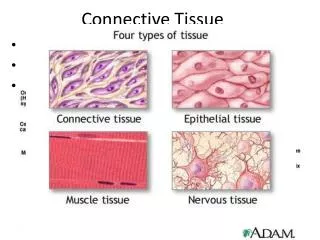
Epithelium Connective tissue Pay attention to the differences b/w Epi & CT
一、CHARACTERISTICS: • Small number of cell large amount of intercellular matrix • Cell: separate and no polarity • Intercellular matrix: fibers + ground substance + tissue fluid • Filled with B.V., L.V., & N. • Function: support, connect, nourish, defence, and repair etc.
二、CLASSIFICATION • Connective tissue proper: Loose C.T. Dense C.T. Adipose tissue Reticular tissue • Cartilage and bone • Blood and Lymph
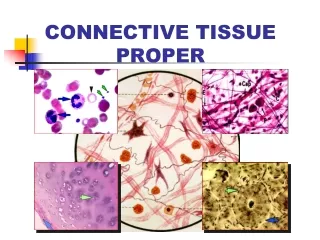
三、LOOSE CONNECTIVE TISSUE I. Characteristics: • Small number of cell & large number of cell category • small number of fibers & great amount of ground substance • Sponge-like structure (areolar tissue) • Distributed b/w cells, tissues and organs.
II. Cells • Fixed cells: fibroblasts fat cells undifferentiated mesenchymal cells • Wandering cells: macrophages plasma cells mast cells leukocytes
F.b. 1、Fibroblasts Structure: Nu: Cytoplasm: EM: rich in rER & r., developed G.l.
F.C. F.b. * Fibrocytes: Function: Synthesize & secrete collagenous pro. & elastic pro. (to form collagenous f., elastic f. & reticular f. ); and ground substance (proteoglycan & glycoprotein).
Mac. F.b. Mac. 2、Macrophages(Histocytes) Structure: Nu.: Cytoplasm:
EM:a large number of Ly., pinosome & phagosomes, bundles of MT & MF
Ag p.s. L.y 残余体 Function: • Mobility chemotaxis chemotactic factor: complement C5a, bacterial products etc. • Phagocytize specific:depend on identify factors: Ab, C, Fibronectin etc (the receptors of these factors are on surface of the macrophge). non-specific:independently
Ag p.s. L.y. • participate in immune regulation capture process antigen present antigen presenting molecular:MHCII Ag-MHCIIco. macrophage surface lymphocytes immune reaction
secrete bioactive products chemotactic factor(for polymorphonuclear leukocytes) immunosuppressive factor leukotriene interleukin(IL) interferon(INF) tumorous necrosis factor(TNF) etc. Source: themonocytes in blood
3、Plasma cells • Structure: Nu.:eccentrically,heterochromatin in wheel shape Cytoplasm: strong basophilic w/ lightly-stained area near Nu. P.C.
EM:rich in rER & r., developed Gl. • Source: B lmphocytes • Function: • synthesize immunoglobulin & cellular factors • participate in humoral immunity
4、Mast cells • Location & Structure: Nu.: Cytoplasm: basophilic granules, metachromatism M.C. B.V. Toluiding blue staining
EM: a great number of granules w/ crystals, containing: heparin, histamine, leukotriene, slow-reacting substance, eosinophil chemotactic factors (ECF-A)
Ag1 Ag2 R Ab-R degranulation plasma cell Ab(Ig E) • Function: • allergic reactions Ag1 plasma cell mast cell Ab(Ig E) R-Ab Ag2 degranulation • anticoagulation • attract eosinophil mast cell
. Ag1 Ab . Plasma cell . . . . . . . . . . . . . . . . . . . . . . . . . . . . . . . . . . . . . . . . . . . . . . . . . . . . . . . . . . . . . . . . . . . . . . . . Ag2 . . . . . . . . . . . . . . . . . . . . . . . . . . . . . . . . . . R-Ab Mast cell
Osmic acid staining HE staining B.V. N b 5、Fat cells (Adipose cells) • Shape: Nu.: Cytoplasm: • Function: synthesize & store lipid
6、Undifferentiated cells • Structure: similar to fibroblasts, smaller • Function: differentiate into various cell-types in C.T. during injury repairing e.g.:
L N 7、Leukocytes • Including: neutrophils, eosinophils, lymphocytes & monocytes • Function: defence involve in allergic reaction (see blood chapter)
III. Fibers: • Collagenous fibers (white f.) • Elastic fibers (yellow f.) • Reticular fibers (argyrophilic f.)
1、Collagenous fibers • Structure: LM: EM: fibrils:have periodic cross-bandings atintervals of 64nm fibrils
Collagen fibrils Collagen fibers
type I type III • Chemicals: collagen type I collagen type III Immunohistochemistry staining
Fibroblast ① ② Synthesize: In rER / GL: → Polypeptide αchains ① → hydroxylated αchains ② → Procollagen ③ In Extracellular space: → Tropocollagen ④ → fibrils ⑤ → collagenous f. ⑥ ③ ④ 280x1.4nm ⑤ ⑥
2、Elastic fibers Structure: LM: EM: elastin + microfibrils (no bandings) F.B.
3、Reticular fibers Sructure: LM:argyrophilia, PAS(+) EM: fibrils w/ periodic cross-bandings at intervals of 64nm, typeIII collagen covered carbohydrate
Reticular fibers in liver Reticular fibers in lymph node
IV.Ground substance • Jelly-like & amorphous substance; • Proteoglycan: in molecular sieve hyaluronic acid GAG(glycosaminoglycan) chondroitin sulfate keratin sulfate etc. protein: core protein & link protein glycoprotein:fibronectin (FN) laminin (LN) chondronectin (ChN);
Side chain subnit hyaluronic acid Collagenous fiber Ground substance Intercellular material
hyaluronic acid side chain subunit link pr. chondroitin sulfate keratin sulfate core pr. Link pr. molecular sieve: hyaluronic acid-- link pr.-- side chain subunit subunit: core protein + chondroitin sulfate & keratin sulfate tissue fluid: flowing through the sieve pores Core pr.
glycoprotein: • fibronectin (FN): produced by epithelial cells and fibroblasts play a role in events of identification, adhesion, migration and proliferation • laminin (LN) : located in B.M., produced by epi. cells, function: adhesion the epi.cells and B.M. • chondronectin (ChN): in cartilage tissue, fuction: a component of ground substances; adhesion chondrocyteS and colagen typeII
Function: • Tissue fluid nourishes the cells & tissues; • Molecular sieve acts as a barrier: to prevent the spread of bacteria & other microorganisms *haemolytic streptococci produce hyaluronidase & promote the invasion • Glycoproteins (FN/LN/ChN): identification /adherence/migration/proliferation etc.
四、DENSE CONNECTIVE TISSUE Characteristics: • Small amount of cells & ground substance, • large number of fibers • Fibers: wide, arranged densely • Function: connect & support
tendons dermis Lig. nuchae Category: Dense regular C.T. (tendons, cornea, ligment): parallel c.f. & tendon cells Dense irregular C.T. (dermis, sclera): collagenous fibers network & fibroblasts Elastic tissue (Lig. Nuchae, Lig. flavum & Large artery ): elastic fibers mainly Large artery
五、ADIPOSE TISSUE • Structure: Loose C.T.+ fat cells (in large aggregations) HE: / Osmic acid: • Function: energy storage, shock absorber, insulating layer
六、RETICULAR TISSUE cells Structure: • Reticular cells + reticular f. + G.S. • Reticular cell: stellate, pale nucleus, obvious nucleoli, processes (rich in rER) Function: architectural framework of lymphatic & hemato- poietic tissues Lymph node fibers