

SlideServe
Menu
Préférences
© SlideServe · v2026

Nuclear Chemistry

fineen avatar
27 diapositives · 448 Views · Jul 26, 2014

This text explores the fundamental principles of nuclear chemistry, focusing on the types of radioactive decay, including alpha, beta, and gamma decay. It outlines the characteristics of radioactive elements, the conservation laws in nuclear reactions, and how nuclear equations are formulated. Detailed examples illustrate the processes of alpha and beta decays, explaining how particles interact and transform within the nucleus. The text aims to enhance comprehension of nuclear reactions and the stability of different isotopes within the scientific framework of radioactivity.
Nuclear Chemistry - slide 1
01 / 27Nuclear Chemistry
1 / 17

Télécharger la présentation

Nuclear Chemistry
Une image / un lien ci-dessous est fourni (tel quel) pour télécharger la présentation

Politique de téléchargement : le contenu du site vous est fourni TEL QUEL pour votre information et votre usage personnel ; il ne peut être vendu, concédé sous licence ni partagé sur d’autres sites sans l’accord de son auteur.Le contenu vous est fourni TEL QUEL, pour votre information et votre usage personnel uniquement. Téléchargez la présentation en cliquant sur ce lien. Lors du téléchargement, si vous ne parvenez pas à télécharger une présentation, l’éditeur a peut-être supprimé le fichier de son serveur.Pendant le téléchargement, si vous ne parvenez pas à obtenir une présentation, le fichier a peut-être été supprimé par l’éditeur.

F I N

Plus de contenu associé

Transcription de la présentation
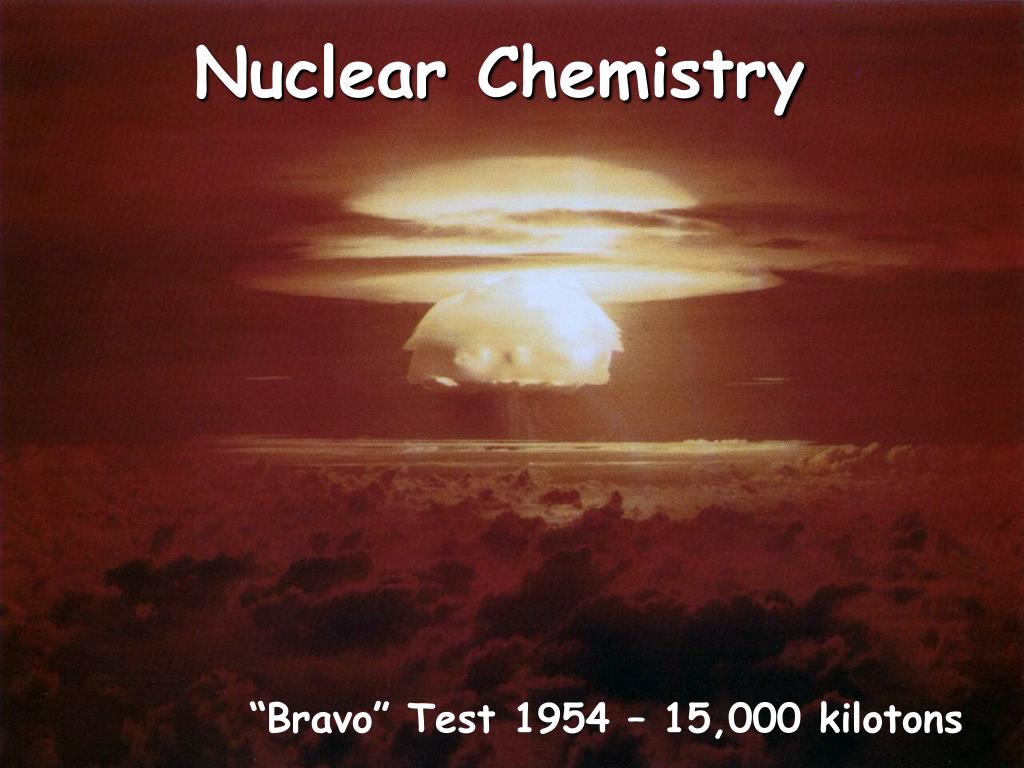
  1. Nuclear Chemistry “Bravo” Test 1954 – 15,000 kilotons

  2. Radioactivity and Nuclear Energy Objective: To learn the types of radioactive decay Objective: To learn to write nuclear equations that describes radioactive decay Objective: To learn how one element may be changed into another by particle bombardment

  3. What makes an atom radioactive? Radioactivity: the spontaneous decomposition of a nucleus to form another nucleus and produce one or more particles. -the neutrons act as glue holding the nucleus together -the heavier the atom, the more likely it is to be radioactive -if the number of protons in the nucleus exceeds 83, then the nuclide is radioactive

  4. Types of Radioactive Decay • alpha production (a, He): helium nucleus • beta production (b, e): • gamma ray production (g):

  5. Specifying Isotopes A X = the symbol of the element A = mass number (protons + neutrons) Z = the atomic number (number of protons) X Z

  6. Nuclear Symbols Mass number, A (p+ + no) Element symbol Atomic number, Z (number of p+)

  7. Key to Understanding Nuclear Reactions In nuclear reactions, both the atomic number Z and the mass number A must be conserved

  8. Balancing Nuclear Equations 222 226 = 4 + ____ 222 Rn 86 86 88 = 2 + ___ Atomic number 86 is radon, Rn

  9. Alpha Decay Alpha production (a): an alpha particle is a helium nucleus Alpha decay is limited to heavy, radioactive nuclei

  10. Alpha (α) Decay an alpha particle (helium nucleus) is produced P+N -4 4 P+N He + E2 E1 P 2 P-2

  11. Alpha Radiation Limited to VERY large nucleii.

  12. Example of Alpha Decay Radium 222 decays by α particle production to Radon 218 4 222 218 He + Rn Ra 88 2 86

  13. Beta Decay Beta production (b): A beta particle is an electron ejected from the nucleus Beta emission converts a neutron to a proton

  14. Beta (β) Decay P+N P+N 0 e + E2 E1 P -1 P+1 Beta emission converts a neutron to a proton

  15. Beta Radiation Converts a neutron into a proton.

  16. Example of Beta Decay Notice the mass of the beta particle is zero; it is so small that is must be neglected. 14 0 14 e N + C 6 -1 7

  17. Example of Beta Decay Thorium 234 decays by β particle production to Protactinium 234 (notice: no change in mass number A, and an increase of 1 in atomic number Z) 234 234 0 e Pa + Th 90 -1 91

  18. Gamma Ray Production Gamma ray production (g): Gamma rays are high energy photons produced in association with other forms of decay. Gamma rays are massless and do not, by themselves, change the nucleus

  19. Gamma Ray Production Gamma ray production (g): Gamma rays are high energy photons produced in association with other forms of decay. Gamma rays are massless and do not, by themselves, change the nucleus

  20. Positron Production Positron emission: Positrons are the anti-particle of the electron Positron emission converts a proton to a neutron

  21. Positron Production P+N P+N 0 e + E2 E1 P 1 P-1 Positron emission converts a proton to a neutron

  22. Electron Capture Electron capture: (inner-orbital electron is captured by the nucleus) Electron capture converts a proton to a neutron

  23. Types of Radiation

  24. NuclearStability Decay will occur in such a way as to return a nucleus to the band (line) of stability. The most stable nuclide is Iron-56 If Z > 83, the nuclide is radioactive

  25. A Decay Series A radioactive nucleus reaches a stable state by a series of steps Graphic – Wikimedia Commons User Tosaka