The Rise of Dictators: Aggression, Appeasement, and the Road to War
This review explores the ascent of dictators in the early 20th century, examining key factors that enabled their rise to power and the consequences of their rule. It discusses the concepts of fascism, totalitarianism, and the use of propaganda, scapegoating, and purges. The study focuses on major aggressions of the 1930s, including Japan's invasions and Hitler's military buildup, which violated the Treaty of Versailles. Additionally, it analyzes the impact of appeasement strategies, as exemplified by the Munich Conference, and their failure to prevent conflict in Europe.

The Rise of Dictators: Aggression, Appeasement, and the Road to War
E N D
Presentation Transcript
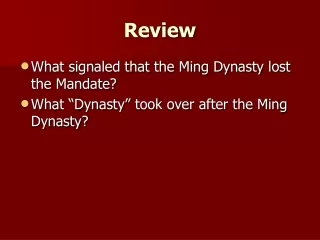
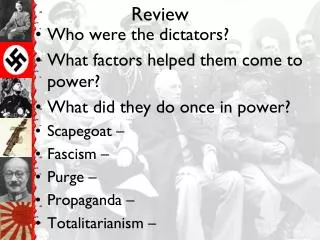
Review • Who were the dictators? • What factors helped them come to power? • What did they do once in power? • Scapegoat – • Fascism – • Purge – • Propaganda – • Totalitarianism –
Road to War: Aggression and Appeasement Mizell, Year II, Humanities
EQs: (1)How did aggression and appeasement lead to war?(2) How did the dictators violate the Treaty of Versailles?
Background • League of Nations was weak • Britain and France want to avoid war • In Germany, Hitler and Nazis desire lebensraum (living space for the German people)
1935 – Hitler ignores Treaty of Versailles and builds up German military
1936 – Hitler occupies the Rhineland (area between France and Germany)
1938 – Hitler wants the Sudetenland (area of Czechoslovakia)
Munich Conference – meeting where Neville Chamberlain of Britain agrees to let Hitler have the Sudetenland to avoid war.Hitler promises not to invade the rest of Czechoslovakia • This is an example of appeasement
What does Appeasement prove to the Dictators? • They can continue to be aggressive because the other countries want to avoid war and must be weak • The League of Nations has no real power
Directions • Use the Appeasement-Aggression sheet to fill in the T-chart and answer the questions on the back of the graphic organizer
Current Aggression • Russia in the Ukraine