Discovering Michigan's Climate: A Year-Round Journey Through Its Four Seasons
50 likes | 177 Vues
Explore the diverse climate of Michigan, characterized by four distinct seasons: warm springs and falls, hot summers, and cold, snowy winters. Understand how temperature and precipitation shape the state's weather patterns over time, with the Lower Peninsula experiencing warmer conditions than the Upper Peninsula. Discover the significant impact of Lake Michigan on local weather, providing cool breezes in summer and generating snowfall in winter. Dive into the intricate relationship between land and lake, and appreciate the beauty of Michigan's seasonal transformations.


Discovering Michigan's Climate: A Year-Round Journey Through Its Four Seasons
E N D
Presentation Transcript
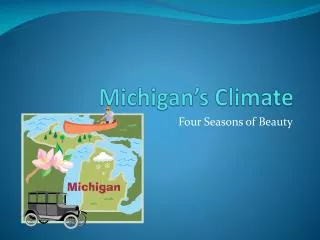
Michigan’s Climate Four Seasons of Beauty
What is Climate? • Weather is how hot or cold or wet or dry a place is at any given time. • Climate is the pattern of weather an area has over time. • Temperature and precipitation (rain, snow, sleet, and hail) affect climate.
Michigan’s Climate • Michigan has all four seasons. • Spring and fall are warm; summer is hot. Winter is cold, and there is usually lots of snow. • Temperatures in the Lower Peninsula are warmer than those in the Upper Peninsula. • Most of Michigan’s precipitation comes as snow in the winter • The Lower Peninsula gets more rain and less snow than the Upper Peninsula.
Lake Effect • Lake Michigan is so large it has an effect on Michigan’s weather. • In the summer, the lake water and air above it are cooler than the land. Cool breezes from the lake cool the land too. • In the winter, the lake water and air are warmer than the land. • Warm winds cross the lake and pick up moisture that makes clouds. As the clouds cross the land, the moisture falls as snow.
Credits • Information contained in this slide show was taken from Michigan a textbook from Macmillan/McGraw-Hill.

![The ONCE and FUTURE [e-] JOURNAL](https://cdn0.slideserve.com/1357417/the-once-and-future-e-journal-dt.jpg)