Understanding Addressing and Port (A+P): Purpose, Origin, and Future in IETF
50 likes | 183 Vues
This document outlines the Addressing and Port (A+P) framework, discussing its purpose and origin. It highlights coexistence scenarios between IPv6-enabled and IPv4-only hosts, detailing how IPv6 sites can efficiently manage shared IPv4 addresses. The text covers the historical context of A+P from 1999 to 2009, including key drafts and discussions at IETF meetings. It also examines various topologies, assignment dynamics, and port management techniques, emphasizing the impact of A+P on network interoperability and traffic management.


Understanding Addressing and Port (A+P): Purpose, Origin, and Future in IETF
E N D
Presentation Transcript
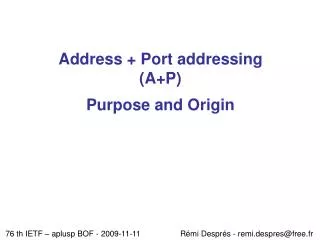
Address + Port addressing(A+P)Purpose and Origin 76 th IETF – aplusp BOF - 2009-11-11 Rémi Després - remi.despres@free.fr
General Scope of A+P • When? • Coexistence period (IPv6-enabled and IPv4-only hosts) • What for? • IPv6 Sites having shared-only IPv4 address • Possible port management by customer sites • Possibly coexistence with ISP NATs • How? • Assign to sites port-restricted IPv4 addresses • Encapsulate IPv4 A+P packets in IPv6 packets A+P purpose and origine
Brief History • 1999-2001 - RSIP (Realm Specific IP - RFC 3103) Experimental protocol for dynamic A+P on mesh topologies • 2008-2009 - revival July 2008: draft-despres-v6ops-apbp-01 Sept 2008: draft-bajko-v6ops-port-restricted-ipaddr-assign-00 Oct 2008: draft-boucadair-port-range-00 Oct 2008: draft-ymbk-aplusp-00 Nov 2008: Common presentation at IETF 73 … Nov 2009: aplusp BOF A+P purpose and origine
Identified Variants WITHIN the Scope • Hubs-and-SpokesorMesh Topologies • Dynamic and/orStatic assignments • Port-range specification: • First&Last ports • Mask&Value of ports • Port Prefix A+P purpose and origine
The IETF 73 Common Presentation … … A+P purpose and origine