
Understanding Angles Through Corresponding and Vertical Angles Theorems
E N D
Presentation Transcript
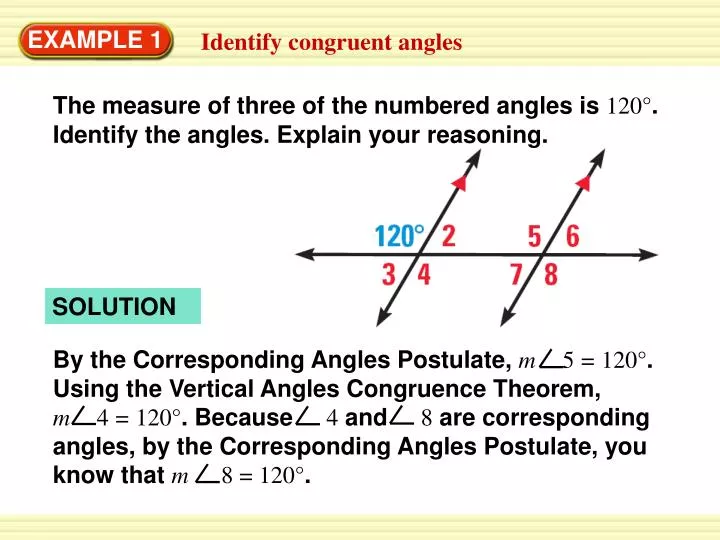
The measure of three of the numbered angles is 120°. Identify the angles. Explain your reasoning. By the Corresponding Angles Postulate, m5=120°. Using the Vertical Angles Congruence Theorem, m4=120°. Because 4 and 8 are corresponding angles, by the Corresponding Angles Postulate, you know that m8 = 120°. EXAMPLE 1 Identify congruent angles SOLUTION
ALGEBRA Find the value of x. By the Vertical Angles Congruence Theorem, m4=115°. Lines aand bare parallel, so you can use the theorems about parallel lines. m4 + (x+5)° 180° = 115° + (x+5)° 180° = Substitute 115° for m4. x + 120 = 180 x = 60 EXAMPLE 2 Use properties of parallel lines SOLUTION Consecutive Interior Angles Theorem Combine like terms. Subtract 120 from each side.
Use the diagram at the right. 1. If m 1 = 105°, find m 4, m 5, and m 8. Tell which postulate or theorem you use in each case. m 4 = m 5 = m 8 = 105° 105° 105° for Examples 1 and 2 GUIDED PRACTICE SOLUTION Vertical Angles Congruence Theorem. Corresponding Angles Postulate. Alternate Exterior Angles Theorem
Use the diagram at the right. 2. If m 3 = 68° and m 8 = (2x + 4)°, what is the value of x? Show your steps. for Examples 1 and 2 GUIDED PRACTICE
180° m 7 + m 8 = m 7 m 3 = 68° 68° + 2x + 4 = 180° Substitute 68° for m 7 and (2x + 4)for 8. 7 and 5 are supplementary. 72 + 2x = 180° m 3 = 2x = 108 x = 54 for Examples 1 and 2 GUIDED PRACTICE SOLUTION Corresponding Angles Postulate. Combine like terms. Subtract 72 from each side. Divide each side by 2.