Download
1 / 13
130 likes | 267 Vues
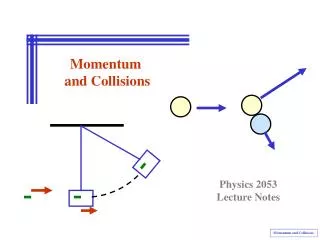
This article explores the concept of momentum and its conservation in collisions, focusing on a car and truck collision scenario. Using Newton's third law, we demonstrate how the total momentum before and after the collision remains constant despite individual momentum changes. We analyze the forces acting during the impact and how they adhere to the conservation principle. The discussion includes mathematical representations, such as momentum equations and vector analysis, to illustrate the dynamics of motion. Visit Physics Classroom for more insights on momentum conservation.

E N D
Car truck collision Fc Ft Ft = mt change in vt time Fc = mc change in vc time Fc time = mc change in vc Ft time = mt change in vt Fc time +Ft time= mc change in vc+mt change in vt (Fc+Ft)time=change in mcvc+change inmtvt (Fc+Ft)time=change in(mcvc+mtvt)
Car truck collision Fc Ft (Fc+Ft)time=change in(mcvc+mtvt) Newton’s 3rd law: Fc= -Ft (Fc+Ft)time= 0 0 = change in(mcvc+mtvt) mcvc+mtvt stays constant!
Momentum = mv mcvc = momentum of car this changes this changes Mtvt= momentum of thruck mcvc+mtvt = total momentum this stays constant Before = -40 After = -40 Momentum is conserved!
True for all collisions before =+20 after =+20 visit www.physicsclassroom.com/mmedia/index.html
Revisit the canoe at the dock Initial momentum canoe = 0 boy = 0 Total = 0 final momentum canoe = mcvc boy = mbvb Total = 0
eating Finding nemo
Billiard balls 2 before after ptot 2 ptot 1 1
Conservation of momentumon a sub-atomic level before p p ptot proton after p ptot p p- meson p- meson
Rocket travel before P0 after P0 + p exhaust p
Rifle recoil mV mV