Understanding Wave Superposition, Interference, and Reflection in Physics
This section explores the principles of superposition, interference, and reflection of waves. When two waves intersect, their amplitudes can typically be added together, leading to constructive or destructive interference depending on their phase difference. Special cases include waves with the same frequency and amplitude, and different phase relationships. Additionally, we examine what occurs when waves reflect off immovable objects and how standing waves are produced by interfering waves traveling in opposite directions, creating fixed points known as nodes.

Understanding Wave Superposition, Interference, and Reflection in Physics
E N D
Presentation Transcript
Physics 2Class 16Wave superposition, interference, and reflection
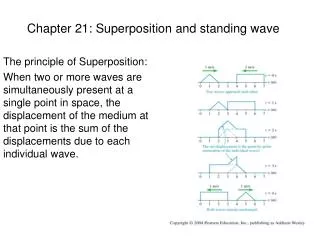
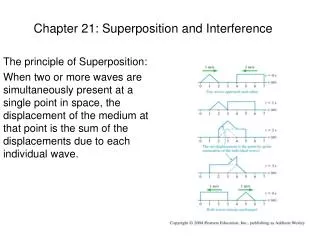
Adding waves: superposition • When two waves are incident on the same place at the same time, their amplitudes can usually just be added. • In the next few slides we will look at some special cases: (both with two waves at the same frequency and with the same amplitude) • same frequency and amplitude • superposition at a point in space • same direction, but different phase • opposite directions
Adding waves • In most simple systems, the amplitude of two waves that cross or overlap can just be added together.
iClicker check 16.1 • For which phase difference is the superposition amplitude a maximum? • =0 • =/2 • =
iClicker check 16.2 • For which phase difference is the superposition amplitude a minimum? • =0 • =/2 • =
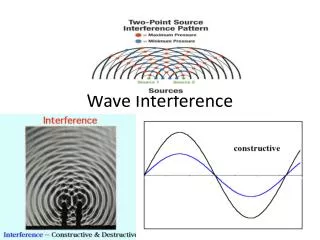
Adding two waves that have the same frequency and direction, but different phase • What happens when the phase difference is 0? • What happens when the phase difference is /2? • What happens when the phase difference is ?
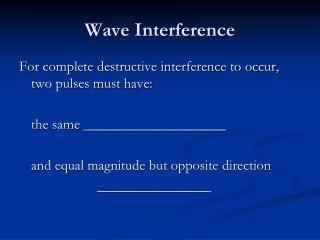
Constructive interference when =0. • Destructive interference when =. Link to animation of two sine waves adding in and out of phase (Kettering)
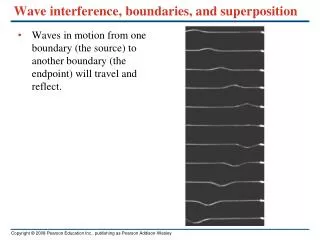
What happens when a wave is incident on an immovable object? • It reflects, travelling in the opposite direction and upside down. (Now watch patiently while your instructor plays with the demonstration.)
Same frequency, opposite directions • What happens when kx is 0? • What happens when kx is /2? • What happens when kx is ? Link to animation of two sine waves traveling in opposite directions
Standing waves • Interfering waves traveling in opposite directions can produce fixed points called nodes. • y1= ym sin(kx – wt) • y2= ym sin(kx + wt) v=w/k • yT = y1 + y2 = 2ym cos(wt) sin(kx) • yT=0 when kx = 0, p, 2p... • yT(t)=maximum when kx = p/2, 3p/2, 5p/2 ...
Fundamental mode (1st harmonic, n = 1) 2nd harmonic, n = 2 Standing waves - ends fixed • Amplitude will resonate when an integer number of half-wavelengths fit in the opening. • Example: violin 5th harmonic, n = 5
Fundamental mode (1st harmonic), n = 1 l=4L/n, n odd 3rd harmonic, n = 3 9th harmonic, n = 9 Standing waves - one end free • Free end will be an anti-nodeat resonance. • Demo: spring (slinky) with one end free.
Fundamental mode (1st harmonic), n = 1 l=2L/n 5th harmonic, n = 5 2nd harmonic, n = 2 Standing waves - both ends free Example: wind instrument