Understanding Wave Interference: Destructive and Constructive Effects in Sound Waves
This article explores wave interference, focusing on complete destructive interference and the conditions required for it, such as matching pulse width and opposite amplitude direction. We will discuss the principle of superposition, demonstrating how two waves combine to create either constructive or destructive interference. Key concepts include the resulting amplitude changes, the phenomenon of beats from slightly different frequencies, and practical applications like noise-reduction headphones. Additionally, we delve into the implications of different frequency ratios on sound perception and the impact of interference patterns in auditoriums.

Understanding Wave Interference: Destructive and Constructive Effects in Sound Waves
E N D
Presentation Transcript
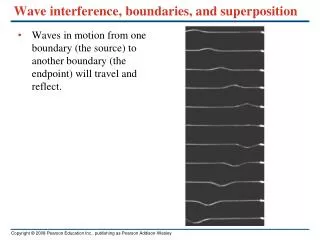
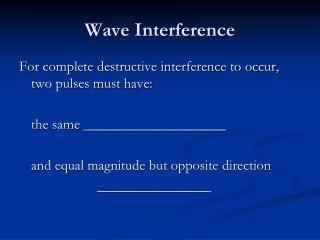
Wave Interference For complete destructive interference to occur, two pulses must have: the same ____________________ and equal magnitude but opposite direction ________________
Wave Interference For complete destructive interference to occur, two pulses must have: the same pulse width or wavelength and equal magnitude but opposite direction amplitude (height)
The Interference of Sound Waves 3U Physics
The Principle of Superposition Recall The Principle of Superposition, which states that when 2 waves interfere, the resulting displacement of the medium at any location is the algebraic sum of the displacements of the individual waves at that same location. Example:
Constructive Interference The sum of two crests is referred to as a ? The sum of two troughs is referred to as a ?.
Constructive Interference The sum of two crests is referred to as a supercrest. The sum of two troughs is referred to as a supertrough.
Destructive Interference Complete destructive interference results in nodes.
The Effect of Interference An increase in amplitude indicates an increase in ?
The Effect of Interference An increase in amplitude indicates an increase in energy, which for sound waves means an increase in the ?
The Effect of Interference An increase in amplitude indicates an increase in energy, which for sound waves means an increase in the intensity or volume of the sound.
Noise-Reduction Headphones Noise-reduction headphones cancel ambient sound by producing sound that is ½ wavelength out of phase with the ambient sound (this works best for single frequencies).
Very Different Frequencies If two very different frequencies are sounded at the same time, the resulting interference pattern will be repeating and therefore sound musical (consonant) if the ratio between the frequencies is a small whole-number ratio:
Very Different Frequencies Frequencies in the ratio of 2:1 are an octave.
Very Different Frequencies The resulting interference pattern will be non-repeating and therefore dissonant if the ratio between the frequencies is not a small whole-number ratio:
Slightly Different Frequencies What if we have two sources with slightly different frequencies? Sometimes the interference will be constructive (increased intensity) and sometimes destructive (decreased intensity).
Different Frequencies This variation in intensity is heard as a variation in volume known as “beats.”
Different Frequencies The beat frequency is equal to the difference between the two frequencies. E.g. if tuning forks of 255 Hz and 257 Hz are struck simultaneously, beats will be heard at a frequency of 2 Hz (2 per second). The closer the frequencies, the lower the beat frequency.
Doppler and Beats Example A car with a siren of 550-Hz is driving toward an observer at a speed of 5 m/s. Another car with a siren of 550 Hz is parked beside the observer. What is the beat frequency heard by the observer? Assume the speed of sound in air is 344 m/s.
Doppler and Beats Example A car with a siren of 550-Hz is driving toward an observer at a speed of 5 m/s. Another car with a siren of 550 Hz is parked beside the observer. What is the beat frequency heard by the observer? Assume the speed of sound in air is 344 m/s.
Doppler and Beats Example A car with a siren of 550-Hz is driving toward an observer at a speed of 5 m/s. Another car with a siren of 550 Hz is parked beside the observer. What is the beat frequency heard by the observer? Assume the speed of sound in air is 344 m/s.
Interference and the Listener Of course, what is heard by the listener will depend on the location of the listener. . . .
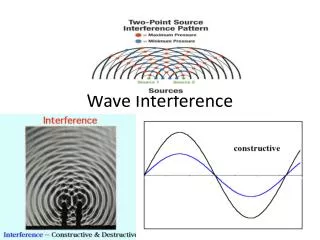
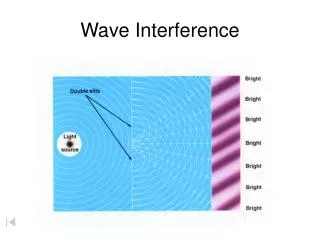
2-Source Interference Two sources (here, two speakers) will produce an interference pattern.
2-Source Interference Two sources (here, two speakers) will produce an interference pattern. Areas of constructive interference will experience an increase in volume.
2-Source Interference Areas of destructive interference (the grey lines, called nodal lines) will experience a decrease in volume.
2-Source Interference Auditoriums and many other public spaces are designed with walls (and ceilings and baffles) that will trap and absorb sound energy rather than reflect it so the reflections cannot interfere with the original waves and distort the sound.
More Practice • The Interference of Sound Waves: An Inquiry Activity • Homework Set 11: Sound Interference