ORGANIC CHEMISTRY
80 likes | 204 Vues
Organic chemistry focuses on carbon-based molecules, which are unique due to carbon's four valence electrons, enabling it to form stable covalent bonds with a variety of other elements. This bonding capability leads to the creation of complex structures such as chains, rings, and macromolecules, making up essential organic compounds like carbohydrates, lipids, nucleic acids, and proteins. Key processes like polymerization, dehydration synthesis, and hydrolysis highlight how monomers unite to form polymers, essential for life’s biological functions.


ORGANIC CHEMISTRY
E N D
Presentation Transcript
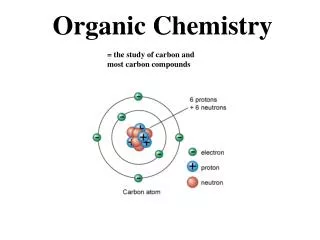
ORGANIC CHEMISTRY THE STUDY OF CARBON-BASED MOLECULES
WHY IS C SO SPECIAL? • 4 VALENCE ELECTRONS!!!! • Therefore, can form strong covalent bonds with four other atoms
4 valence electrons is important because… • Bonds with many other elements • Bonds with other carbon, with single, double, triple atoms • Result: huge, complex molecules (chains, rings, balls)
4 groups of organic compounds • Carbohydrates • Lipids • Nucleic acids • Proteins
POLYMERIZATION • When you link up monomers(individual molecular unit), you get polymers • The process is called polymerization • Giant molecules are also called macromolecules
Polymers Monomers • Carbohydrates • a.k.a.polysaccharides • Lipids • Nucleic acids • Ex. DNA, RNA • Proteins • a.k.a.polypeptide chains • Monosacharrides • N/A • Nucleotides • Amino acids
POLYMERIZATION terms: • Dehydration synthesis: when monomers join together to synthesize polymers, and get dehydrated in the process • Hydrolysis: when a polymer is broken into its monomers, and gets hydrated with water molecules in the process
Polymerization Animation links • http://highered.mcgraw-hill.com/sites/0072507470/student_view0/chapter25/animation__enzyme_action_and_the_hydrolysis_of_sucrose.html • http://www.tvdsb.on.ca/Westmin/science/sbioac/biochem/condense.htm • http://nhscience.lonestar.edu/biol/dehydrat/dehydrat.html