Download
1 / 15
150 likes | 278 Vues
This resource explores the concepts of quadrants and reference angles in the unit circle. Students will learn how to determine positive and negative coterminal angles, convert between degrees and radians, and identify reference angles. The unit circle, which has a radius of 1 and is centered at the origin, is introduced with key coordinates and angles. Practice problems are included to reinforce understanding of reference angles and their significance in simplifying trigonometric evaluations throughout the semester.

E N D
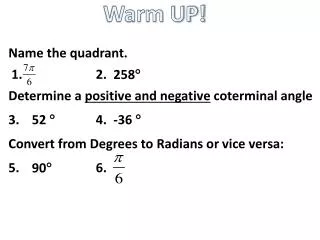
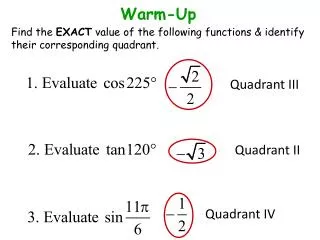
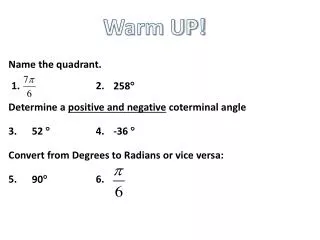
Warm UP! Name the quadrant. 1. 2. 258 Determine a positive and negative coterminal angle 3. 52 4. -36 Convert from Degrees to Radians or vice versa: 5. 90 6.
LG 1-2 THE Unit Circle Agenda: Notes Practice
Reference angles • the angles formed between the terminal side of an angle in standard position and the closest side of the x-axis. • All reference angles measure between 0o and 90o • You will use reference angles when filling out the unit circle. • They are helpful because you can memorize less of the UC if you use reference angles.
45o 120o 275o 195o
Practice: Find the reference anglesDo the problem number with the number of letters in your first name! • 300o • 210o • 135o • 585o • 30o • 870o • -45o • -200o • -900o • (and up) -314o
The Unit Circle is a circle centered at the origin on the coordinate plane with radius = 1
(0,1) (1,0) First Quadrant 60° 1 90° 30°
(0,1) 45° 1 90° 45° (1,0)
(0,1) 30° 1 60° (1,0)
Memorize these coordinates on the unit circle. We will use them for the rest of the semester!
Unit Circle Videos • Hand-trick for evaluating exact values • Another trick for evaluating • Memorizing the Unit Circle • More memorizing • Unit Circle song • Another Unit Circle song • Reference Angles