Enhancing Autonomous Surface Vehicle (ASV) for RoboBoat Competition 2012
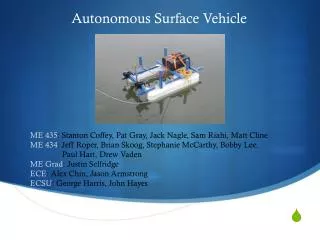
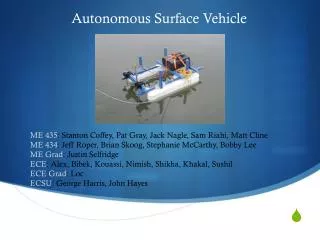
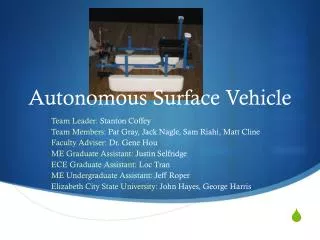
This project focuses on the design and management of an Autonomous Surface Vehicle (ASV) aimed at improving its performance for the Summer 2012 RoboBoat Competition. The ASV is designed to operate autonomously in hazardous environments and enhance navigation using advanced sensors like LiDAR, along with computer vision techniques. The primary objectives include speed testing and navigating a buoy-based course. The team comprises faculty and graduate advisors, with a strategic approach to integrating technology and conducting rigorous evaluations.

Enhancing Autonomous Surface Vehicle (ASV) for RoboBoat Competition 2012
E N D
Presentation Transcript
Autonomous Surface Vehicle Project MAE 435 Project Design and Management II 19 October, 2011
ASV MAE Team Members Advisors Team A Team B • Dr Gene Hou (Faculty Advisor) • Justin Selfridge (Graduate Advisor) • Stanton Coffey (Graduate Advisor) • Brian Skoog • John Lee • Jeff Roper • Paul Hart • Stephanie Mccarthy • Andrew Vaden • John Bernas • Eric Starck • Jason Putman • Kevin Mcleod
ASV ECE Team Members Advisors Students • Dr Chung-Hao Chen (Faculty Advisor) • Nimish Sharma • Justin Maynard • Robert Tolentino • Bibek Shrestha • Sushil Khadka
Autonomous Surface Vehicle-ASV • What is it? • Vehicle (boat) that can operate with no human interaction • Why do we need them? • ASVs can operate in environments that are dangerous to humans (nuclear, biological, space, etc)
Objective • Improve current ASV for the Summer 2012 Association for Unmanned Vehicle Systems International annual RoboBoat Competition
RoboBoat Competition • Primary Tasks • Speed Test • Locate and complete a straight course as fast as possible • Navigation Test • Navigate a course of buoys with several turns and obstacles • Secondary Tasks
Solution Approach • Determine/purchase sensors that provide competitive performance • Determine a navigation logic • Integrate all sensors • Test and evaluate sensors and navigation logic • Debug and modify as required • Install electronics on boat • Test and evaluate ASV
Upgrades in Progress • Computer Vision code • LiDAR • Sensor gimbal mount • Navigation Logic • New onboard computer • Arduino integration
Computer Vision • Primarily for buoy color detection • Inputs directly to onboard computer • Vision information only extracted when LiDAR detects object
LiDAR • Light Detection And Ranging • Primary Navigation Sensor • Inputs directly to onboard computer • 240 degree FOV • 5.2 meter radius
Sensor Gimbal Mount • Required to keep LIDAR and cameras level • Uses Ardupilot gyro and accelerometer sensors to detect motion
Navigation Logic • Defined scenarios based on: • Distance to buoys • Color of buoys • Approach angle • LiDAR as primary sensor • Computer Vision as secondary sensor
New Onboard Computer • Custom build/Watercooled • Intel Core i3-2100T • Low Power consumption • Dual core/Hyperthreading Technology • M4-ATX-HV DC-DC Power Converter • 250 Watts maximum • 6-34v DC wide input • Will run on boat battery
Onboard Computer Cont. Not to Scale Inside Waterproof Box HDD Pump/ Reservoir Power CPU RAM Radiator Motherboard Wireless
Arduino Integration • Ardupilot integrated sensors • GPS • Gyro • Compass • Accelerometer
Summary • Improve current ASV in order to be more competitive in RoboBoat competition primary tasks • Integrate LiDAR as primary navigation sensor • Build gimbal mount for navigation sensors • Integrate Ardupilot • Upgrade computer hardware to improve processing speed and electronics case cooling