Understanding the Divisibility Rule for 6: Quick Guide and Examples
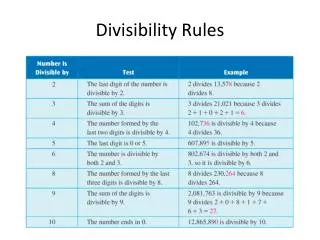
The divisibility rule for 6 states that a number must be divisible by both 2 and 3. To determine if a number is divisible by 6, first check if it ends in an even digit (for divisibility by 2), and then assess if the sum of its digits is divisible by 3. For instance, the number 876,453 is not divisible by 6 because it is not even. In contrast, 45,672,978 is divisible by 6 as it fulfills both criteria. Explore examples to master this rule!

Understanding the Divisibility Rule for 6: Quick Guide and Examples
E N D
Presentation Transcript
The divisibility rule for 6 is as follows: • If the number can be divided by BOTH 2 and 3 • Ex. Determine whether the number 876 453 is divisible by 6 • Solution: • the last digit is not even, so the number is not divisible by 2. • 8+7+6+4+5+3=33 • 3+3=6 • 6/2=3 • Since 3 is a factor of 33, the number is divisible by 3 • Therefore, 6 is not a factor of 876 453 because 2 is not a factor
Example #1 • Determine whether the number 839 729 384 192 is divisible by 6. • Solution: • 8+3+9+7+2+9+3+8+4+1+9+2= 65 • 6+5=11 • Therefore, 6 is not a factor of 839 729 384 192 because 3 is not a factor
Example#2 • Determine whether the number 45 672 978 is divisible by 6 • Solution: • 4+5+6+7+2+9+7+8=48 • 4+8= 12 • 12/3=4 • Therefore, 6 is a factor of 45 672 978 because 2 and 3 are factors.
Your Turn • Explain whether the number 186 is divisible by 6. • 1+8+6= 15 • 1+5=6 • 6/3=2 • Yes it is.
Your Turn • Explain whether the number 283 945 is divisible by 6. • 2+8+3+9+4+5= 31 • 3+1=4 • 4/3 • No
Practice • Page 13 #1 • STOP and CHECK • Continue onto #3, 5, 6, 7, 8