Understanding Damped and Forced Simple Harmonic Motion in Physics
310 likes | 436 Vues
In this lecture presented by Professor Lee Carkner, we explore the principles of damped and forced simple harmonic motion (SHM). Key topics include the effects of increasing amplitude on parameters such as period, spring constant, total energy, maximum velocity, and maximum acceleration. We also examine the relationship between pendulum motion and path length, alongside real-world applications like adjusting clock pendulums. Furthermore, concepts of resonance and energy dissipation in damped systems are addressed, providing a comprehensive look at SHM and its complexities.


Understanding Damped and Forced Simple Harmonic Motion in Physics
E N D
Presentation Transcript
Damped and Forced SHM Physics 202 Professor Lee Carkner Lecture 5
If the amplitude of a linear oscillator is doubled, what happens to the period? • Quartered • Halved • Stays the same • Doubled • Quadrupled
If the amplitude of a linear oscillator is doubled, what happens to the spring constant? • Quartered • Halved • Stays the same • Doubled • Quadrupled
If the amplitude of a linear oscillator is doubled, what happens to the total energy? • Quartered • Halved • Stays the same • Doubled • Quadrupled
If the amplitude of a linear oscillator is doubled, what happens to the maximum velocity? • Quartered • Halved • Stays the same • Doubled • Quadrupled
If the amplitude of a linear oscillator is doubled, what happens to the maximum acceleration? • Quartered • Halved • Stays the same • Doubled • Quadrupled
If you have a pendulum of fixed mass and length and you increase the length of the path the mass travels, what happens to the period? • Increase • Decrease • Stays the same
If you have a pendulum of fixed mass and length and you increase the length of the path the mass travels, what happens to the maximum velocity? • Increase • Decrease • Stays the same
If you have a pendulum of fixed mass and length and you increase the length of the path the mass travels, what happens to the maximum acceleration? • Increase • Decrease • Stays the same
The pendulum for a clock has a weight that can be adjusted up or down on the pendulum shaft. If your clock runs slow, what should you do? • Move weight up • Move weight down • You can’t fix the clock by moving the weight
PAL #4 Pendulums • The initial kinetic energy is just the kinetic energy of the bullet • ½mv2 = (0.5)(0.01 kg)(500 m/s)2 = • The initial velocity of the block comes from the kinetic energy • KE = ½mv2 • v = (2KE/m)½ = ([(2)(1250)]/(5))½ = • Amplitude =xm, can get from total energy • Initial KE = max KE = total E = ½kxm • xm =(2E/k)½ = ([(2)(1250)]/(5000))½ = • Equation of motion = x(t) = xmcos(wt) • k = mw2 • w = (k/m)½ = [(5000/(5)]½ = 31.6 rad/s
Uniform Circular Motion • Simple harmonic motion is uniform circular motion seen edge on • Consider a particle moving in a circle with the origin at the center • The projection of the displacement, velocity and acceleration onto the edge-on circle are described by the SMH equations
Uniform Circular Motion and SHM y-axis Particle moving in circle of radius xm viewed edge-on: cos (wt+f)=x/xm x=xm cos (wt+f) Particle at time t xm angle = wt+f x-axis x(t)=xm cos (wt+f)
Observing the Moons of Jupiter • He discovered the 4 inner moons of Jupiter • He (and we) saw the orbit edge-on
Application: Planet Detection • The planet cannot be seen directly, but the velocity of the star can be measured • The plot of velocity versus time is a sine curve (v=-wxmsin(wt+f)) from which we can get the period
Orbits of a Star+Planet System Center of Mass Vplanet Star Planet Vstar
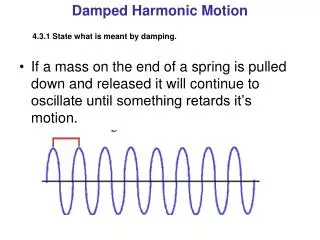
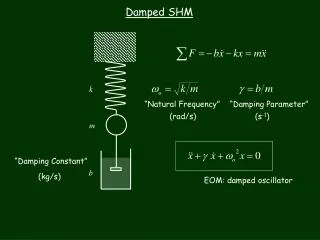
Damped SHM • Consider a system of SHM where friction is present • The damping force is usually proportional to the velocity • If the damping force is represented by Fd = -bv • Then, x = xmcos(wt+f) e(-bt/2m) • e(-bt/2m) is called the damping factor and tells you by what factor the amplitude has dropped for a given time or: x’m = xm e(-bt/2m)
Energy and Frequency • The energy of the system is: E = ½kxm2 e(-bt/m) • The period will change as well: w’ = [(k/m) - (b2/4m2)]½
Damped Systems • Most damping comes from 2 sources: • Air resistance • Example: • Energy dissipation • Example: • Lost energy usually goes into heat
Forced Oscillations • If you apply an additional force to a SHM system you create forced oscillations • If this force is applied periodically then you have 2 frequencies for the system wd = the frequency of the driving force • The amplitude of the motion will increase the fastest when w=wd
Resonance • Resonance occurs when you apply maximum driving force at the point where the system is experiencing maximum natural force • Example: pushing a swing when it is all the way up • All structures have natural frequencies
Next Time • Read: 16.1-16.5 • Homework: Ch 15, P: 95, Ch 16, P: 1, 2, 6
Summary: Simple Harmonic Motion x=xmcos(wt+f) v=-wxmsin(wt+f) a=-w2xmcos(wt+f) w=2p/T=2pf F=-kx w=(k/m)½ T=2p(m/k)½ U=½kx2 K=½mv2 E=U+K=½kxm2
Summary: Types of SHM • Mass-spring T=2p(m/k)½ • Simple Pendulum T=2p(L/g)½ • Physical Pendulum T=2p(I/mgh)½ • Torsion Pendulum T=2p(I/k)½
Summary: UCM, Damping and Resonance • A particle moving with uniform circular motion exhibits simple harmonic motion when viewed edge-on • The energy and amplitude of damped SHM falls off exponentially x = xundamped e(-bt/2m) • For driven oscillations resonance occurs when w=wd